
How to comply with new rules for privacy assessments, automated decisionmaking, & cybersecurity audits
Thank you!
Please check your email to view the guide.
OneTrust vs Ketch: which one is the best choice in 2026?
August 31, 2026
5
mins read
Author


Privacy compliance has moved from a legal checkbox to an operational requirement. Two platforms come up repeatedly in this conversation: OneTrust and Ketch. OneTrust is the dominant enterprise suite. Ketch is the newer, API-first alternative.
The core question buyers face while comparing OneTrust vs Ketch is not which platform has more features. It is whether the team needs a full compliance suite or a flexible privacy layer and whether either one actually verifies that consent is being enforced in production.
So which privacy tool should you choose? This article breaks down how both platforms compare across features, pricing, implementation, and use cases, and identifies the gap neither one covers.
How we evaluated OneTrust vs Ketch?
Choosing between privacy platforms isn't easy because much of the information buyers care about, including pricing, implementation effort, and day-to-day usability, isn't fully available on vendor websites.
To build this comparison, we combined official product documentation from OneTrust and Ketch with procurement benchmarks from Vendr, verified customer reviews from G2, Gartner Peer Insights, TrustRadius, and Capterra, and publicly available documentation covering integrations, implementation, and product capabilities. Where relevant, we also referenced publicly available customer case studies and product announcements to verify platform capabilities.
Rather than comparing feature checklists alone, this article focuses on the questions buyers typically ask during evaluation: Which platform is easier to implement? Which offers better value? Which is better suited to your team's way of working? And where does each platform fall short?
Quick overview of OneTrust vs Ketch
OneTrust and Ketch both help organizations manage privacy compliance, but they're built for different priorities. OneTrust is a broad enterprise platform for privacy operations and governance, while Ketch focuses on developer-first consent and privacy infrastructure.
Here's a high-level comparison of how both platforms compare across positioning, implementation, ecosystem, and G2 ratings.
What is OneTrust?
.webp)
Source: OneTrust website
Founded in 2016, OneTrust is a widely used enterprise privacy platform, helping organizations manage privacy, compliance, and data governance from a single platform. Today, its portfolio is organized into six solution areas: Consent & Preferences, Privacy Automation, Tech Risk & Compliance, Third-Party Management, AI Governance, and Data Use Governance.
These solutions cover everything from consent management and Data Subject Request (DSR) automation to privacy assessments, data mapping, Governance, Risk, and Compliance (GRC), third-party risk management, AI governance, and responsible data use.
Beyond product capabilities, OneTrust differentiates itself through its regulatory intelligence. Its DataGuidance platform tracks regulatory developments across 300+ jurisdictions, making it particularly useful for organizations operating across multiple countries and regulatory frameworks.
Like most enterprise software platforms, OneTrust doesn't publish fixed pricing. Organizations receive a custom quote based on the products they license, implementation scope, and licensing metrics such as Average Daily Unique Visitors (ADUVs), admin users, vendor inventory, and privacy assets. Contracts start at OneTrust's $10,000 annual minimum, and enterprises running several modules typically pay $120,000 to $500,000 or more. A Forrester Total Economic Impact™ study commissioned by OneTrust models a composite enterprise organization paying around $292,000 a year for the platform.
OneTrust is best suited for organizations looking for a single platform to manage privacy operations, governance, and regulatory compliance at enterprise scale.
| Related Read - 13 Best OneTrust Competitors and Alternatives in 2026
What is Ketch?
.webp)
Source: Ketch website
Ketch is an API-first privacy platform built to help organizations collect, enforce, and operationalize privacy choices across websites, applications, data systems, and AI initiatives. Rather than focusing only on consent collection, Ketch positions itself as a data permissioning platform that connects privacy choices to how data is actually used across the business.
Its platform includes Consent Management, DSR Automation, Marketing Preference Management, Data Mapping & Discovery, Risk Management & Reporting, AI Governance, and Data Sentry for detecting privacy risks across digital properties. Organizations can adopt these products individually or combine them into a broader privacy program.
One of Ketch's differentiators is its developer-first architecture. The platform provides APIs, Software Development Kits (SDKs), webhooks, and 1,000+ integrations to connect privacy signals with CRM systems, Customer Data Platforms (CDPs), analytics tools, cloud data warehouses, advertising platforms, and internal applications.
Unlike OneTrust, Ketch publishes entry-level pricing for its Consent Management Platform (CMP), starting with a Free plan, followed by Starter ($150/month) and Plus (from $499/month) plans, while larger organizations can purchase a custom-priced Pro plan or license individual products such as DSR Automation or Data Mapping separately.
Ketch is best suited for engineering-led organizations that want privacy controls embedded directly into their technology stack while retaining the flexibility to add broader privacy capabilities as their program matures.
Detailed feature comparison of OneTrust & Ketch
When buyers compare Ketch vs OneTrust, the discussion usually comes down to six areas: consent management, DSAR automation, data mapping, integrations, developer experience, and compliance reporting. Both platforms cover these fundamentals, but they approach them differently. OneTrust emphasizes governance and structured privacy operations, while Ketch focuses on embedding privacy decisions directly into business systems.
1. Consent management
Both OneTrust and Ketch support the capabilities expected from an enterprise CMP, including customizable cookie banners, geo-targeted experiences, Google Consent Mode v2, Interactive Advertising Bureau Transparency and Consent Framework (IAB TCF) support, and compliance with regulations such as the General Data Protection Regulation (GDPR) and the California Consumer Privacy Act (CCPA).
The difference lies in how consent decisions are enforced after a visitor makes a choice.
OneTrust enables privacy teams to configure consent experiences and enforcement rules through a centralized interface. It also provides automated cookie discovery, consent logging, and script blocking to prevent trackers from firing before consent is collected. Enforcement relies on correctly configuring tags, scripts, and downstream integrations.
Ketch approaches consent as a data permissioning problem. Consent preferences are stored centrally and propagated across connected systems through APIs and integrations, allowing downstream marketing, analytics, and customer data platforms to receive and enforce those decisions consistently.
G2 users rate both platforms similarly for CMP capabilities (OneTrust 8.4/10, Ketch 8.5/10), suggesting that both solutions meet enterprise consent management requirements well.
Verdict:
OneTrust is a better fit for organizations that want centralized consent governance managed primarily by privacy teams.
Ketch is a better fit for organizations that want consent preferences propagated across their technology stack as part of operational privacy workflows.
Consent management and consent monitoring solve different problems. As websites and applications evolve, new trackers, scripts, and integrations can unintentionally bypass existing consent configurations. Continuous consent monitoring complements consent management by verifying that user choices are still being honored in production and helping teams identify issues introduced after deployment.
2. Data Subject Access Rights (DSAR) handling
Both platforms automate the full DSAR lifecycle, including request intake, identity verification, request tracking, fulfillment, and audit logging.
OneTrust integrates DSAR management into its broader Privacy Automation platform, enabling organizations to manage requests alongside assessments, data mapping, Records of Processing Activities (RoPAs), and other governance workflows. This makes it well-suited for organizations handling high request volumes across multiple business units or jurisdictions.
Ketch emphasizes automation throughout the fulfillment process. Organizations can build configurable workflows, automate stakeholder assignments, and fulfill requests across connected systems with minimal manual intervention.
Customer satisfaction is nearly identical, with G2 users rating OneTrust 9.1/10 and Ketch 9.0/10 for DSAR capabilities.
Verdict:
OneTrust is a better fit for organizations managing DSARs as part of a broader privacy governance program.
Ketch is a better fit for teams looking to reduce manual effort by automating fulfillment across connected systems.
3.Data mapping and discovery
Both platforms provide automated data discovery and mapping, but they prioritize different outcomes.
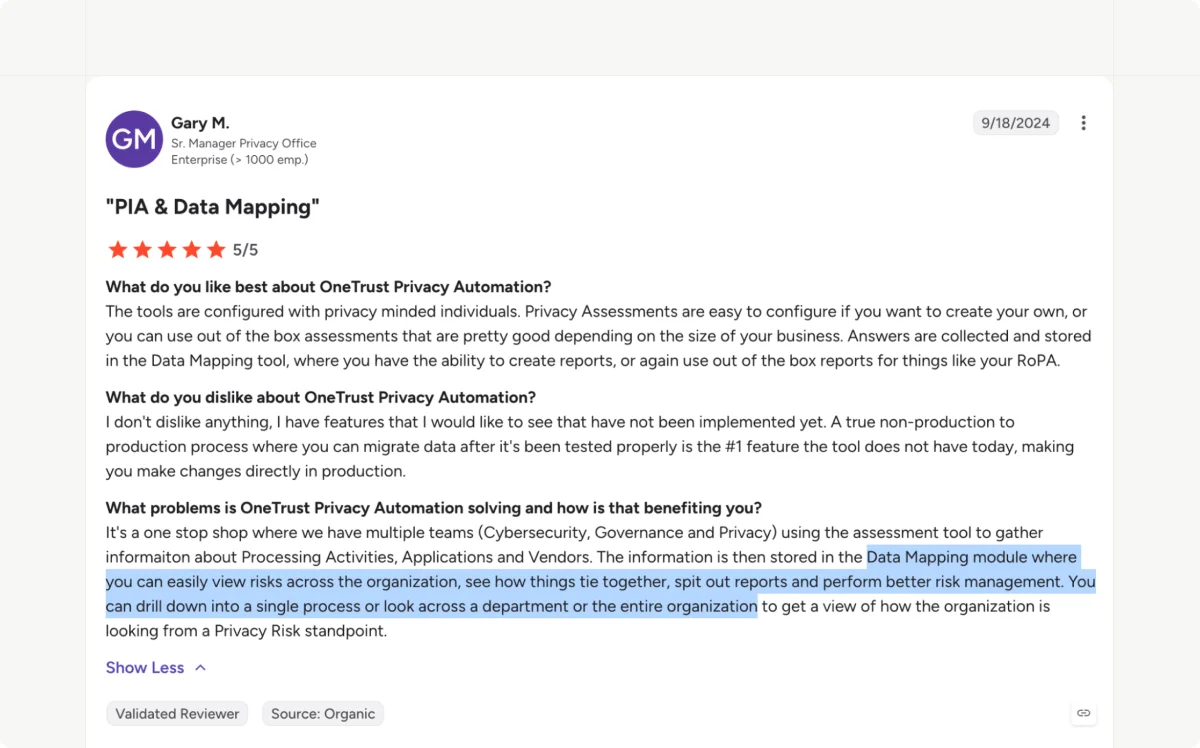
OneTrust discovers structured and unstructured personal data across cloud, on-premises, and hybrid environments. It combines automated discovery with manual assessments to capture business context such as processing purposes and legal bases, making it easier to maintain governance documentation and RoPAs.
Ketch combines automated discovery and classification with its consent and privacy rights platform. Rather than functioning as a standalone inventory, discovered data feeds downstream workflows such as consent enforcement, risk assessments, and DSAR fulfillment.
Source: G2 reviews, OneTrust
This difference is reflected in G2's Data Privacy Management ratings, where OneTrust scores 8.7/10 compared with Ketch's 8.1/10, indicating stronger customer satisfaction with its governance capabilities.
Verdict:
OneTrust is a better fit for organizations that need full data inventories and governance documentation.
Ketch is a better fit for organizations that want continuously updated data maps powering operational privacy workflows.
4. Integrations and ecosystem
OneTrust's integration ecosystem is built around enterprise IT and GRC infrastructure. The platform connects with tools like Microsoft Purview, ServiceNow, Snowflake, Databricks, and Salesforce and offers 500+ out-of-the-box connectors for data discovery and classification.
On the other hand, Ketch's ecosystem is oriented around marketing, advertising, and data infrastructure. The platform offers 1,000+ pre-built integrations across Customer Data Platforms (CDP), CRMs, analytics tools, ad networks, and data warehouses.
OneTrust's integration depth is broader across GRC and compliance use cases, connecting with enterprise infrastructure tools like ServiceNow, Microsoft Purview, and Snowflake. Ketch's integrations are more tightly coupled with the consent and data layer - CDPs, ad networks, and analytics tools, which is the more relevant footprint for teams whose primary concern is making sure consent choices are reflected across their marketing stack.
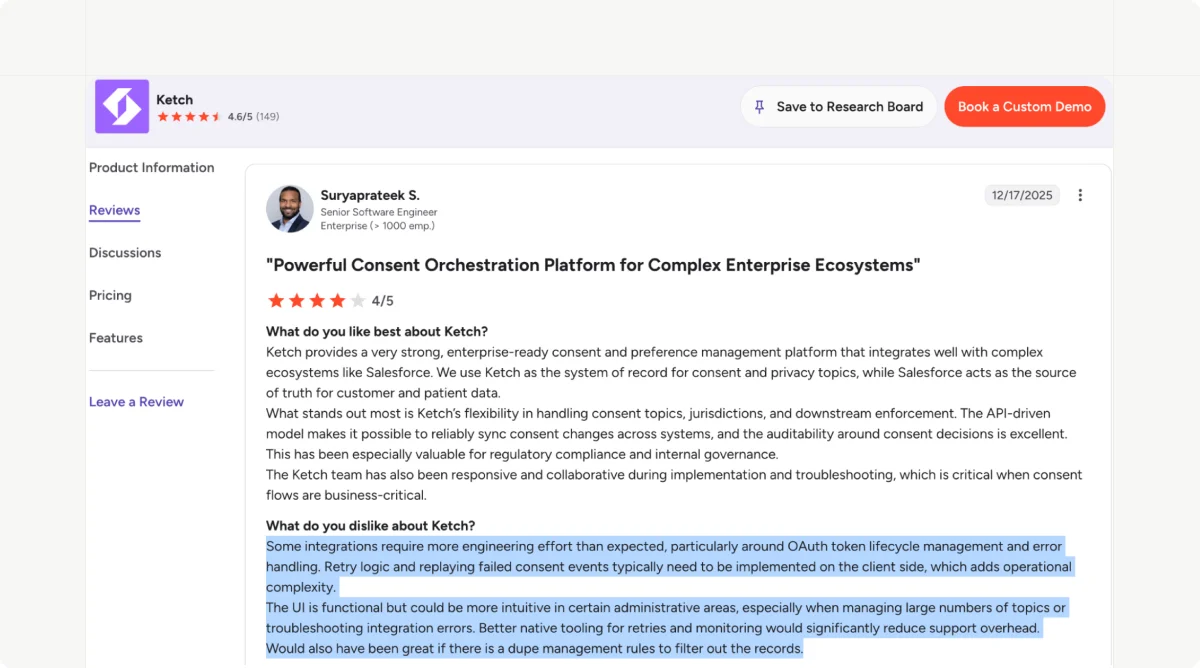
One caveat worth noting: several G2 reviewers report that Ketch integrations can require more engineering effort to troubleshoot than the initial setup suggests, particularly around OAuth token management and error handling.
5. Developer experience
OneTrust combines APIs and SDKs with a dashboard-driven interface that enables privacy teams to configure policies and workflows without extensive developer involvement.
Ketch follows an API-first architecture designed to embed consent and privacy controls directly into applications while also providing no-code tools for privacy teams. This allows engineering and privacy teams to collaborate without relying entirely on custom development.
This difference is reflected in G2's Ease of Setup ratings, where Ketch scores 8.5/10 compared with OneTrust's 7.8/10.
Verdict:
OneTrust is a better fit for organizations where privacy teams primarily manage compliance through centralized workflows.
Ketch is a better fit for engineering-led organizations that want greater flexibility to integrate privacy controls into their applications.
6. Reporting and compliance readiness
OneTrust offers audit logs, regulatory reporting, and built-in regulatory intelligence through DataGuidance, which is a research platform that tracks changes across 300+ jurisdictions with input from 2,000+ legal experts. This is stronger for teams that need to stay ahead of what regulations require across multiple frameworks and geographies.
Ketch provides compliance reporting and audit trail capabilities through its Privacy 360 Analytics Suite, which generates identity-linked, timestamped logs of every consent decision, opt-out, and DSR action. This is better for teams that need to prove enforcement happened when a regulator, auditor, or plaintiff's attorney asks.
Verdict:
OneTrust is a better fit for organizations that need regulatory intelligence alongside enterprise privacy governance.
Ketch is a better fit for organizations focused on operational reporting that demonstrates how consent and privacy requests are executed across their technology stack.
Pricing comparison of OneTrust and Ketch
OneTrust and Ketch take different approaches to pricing transparency. OneTrust requires organizations to contact sales for a custom quote, while Ketch publicly publishes pricing for its Consent Management Platform (CMP) and reserves custom pricing for its enterprise privacy platform.
OneTrust follows a modular licensing model, where products such as Consent & Preferences, Privacy Automation, Third-Party Risk Management, AI Governance, and Data Governance are licensed separately. This gives organizations flexibility to expand their privacy program over time, but costs can increase as additional modules and services are added.
| Related Read - OneTrust Pricing: How Much Does It Cost in 2026 and Is It Worth It?
Ketch's pricing is more transparent for organizations that only need a CMP. Every publicly listed plan includes the platform's core consent management capabilities, including customizable privacy experiences, website tracker scanning, consent record storage, and privacy law templates. Enterprise capabilities such as DSR Automation, Data Mapping, Risk Assessments, and Marketing Preference Management are available through the custom-priced Pro plan.
Vendr's procurement benchmarks indicate that. OneTrust runs roughly a third higher than Ketch at entry level and 50–60% higher at enterprise scale, with the gap widening as modules are added.. Buyers evaluating either platform should also consider implementation costs, ongoing administration, and future expansion alongside the initial software price.
Implementation: why this is where OneTrust loses mid-market teams
Implementation is one of the biggest differences when comparing Ketch vs OneTrust. While both platforms require planning and integration, customer reviews suggest that Ketch is generally easier to deploy and manage, particularly for mid-market organizations with smaller privacy teams.
A Forrester Total Economic Impact study found that OneTrust implementations can take 9 to 18 months, involve multiple internal resources, require external professional services, and include ongoing platform administration. These findings highlight the level of investment organizations may need when deploying the platform.
For lean privacy teams, that level of implementation effort can make faster-to-deploy alternatives more attractive.
On G2's experience metrics - as distinct from the capability scores above, where OneTrust leads on data mapping and DSARs - Ketch is ahead across the board
- Ease of Setup: Ketch 8.5 vs OneTrust 7.8
- Usability: Ketch 8.7 vs OneTrust 8.2
- Ease of Admin: Ketch 8.8 vs OneTrust 8.4
- Support: Ketch 9.7 vs OneTrust 8.6
OneTrust's broader platform is one reason for this. Beyond consent management, many implementations also involve configuring data mapping, privacy assessments, workflows, integrations, and governance processes. Several G2 reviewers mention that deployment requires significant planning and configuration before the platform delivers value.
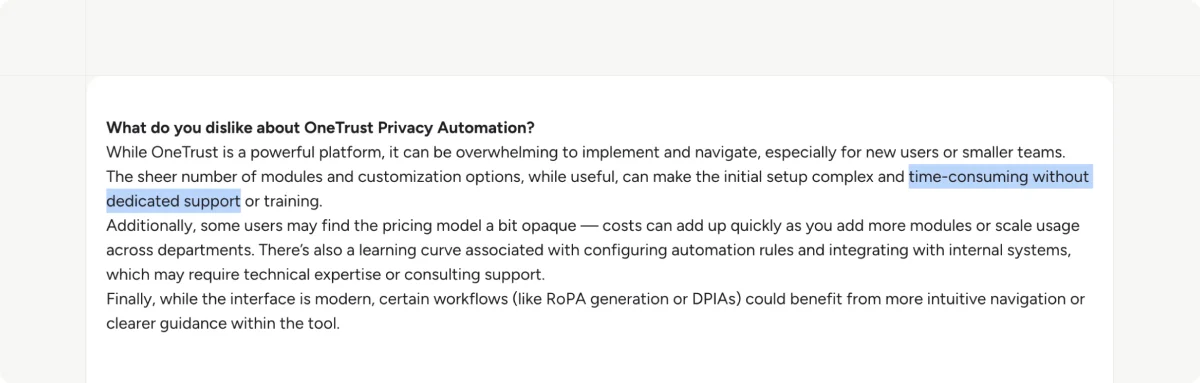
This aligns with what privacy leaders are prioritizing today. In Assemble's 2026 Decision Intelligence Benchmark, efficiency and time savings ranked as the top driver behind privacy technology decisions (44%), ahead of new capabilities or cost reduction, making lengthy implementations harder to justify for lean teams.
What users say about Ketch implementation:
Ketch takes a more focused approach. Customers frequently mention a straightforward onboarding process, and one enterprise G2 reviewer reported having pilot websites running within hours. Ketch also states that many customers complete migrations in 2–4 weeks, depending on the scope of the deployment.
That said, implementation speed depends on the organization's technical resources. Ketch's API-first architecture works best when engineering teams are available to configure integrations and embed privacy controls into existing systems. Organizations with limited developer support may not experience the same deployment timeline, although the platform also includes no-code tools for privacy teams.
For organizations evaluating total cost of ownership, implementation effort is just as important as licensing costs. Teams with dedicated privacy engineering resources may appreciate Ketch's faster deployment model, while larger enterprises with mature governance programs may be willing to invest more time upfront to implement OneTrust's broader platform capabilities.
Where OneTrust wins
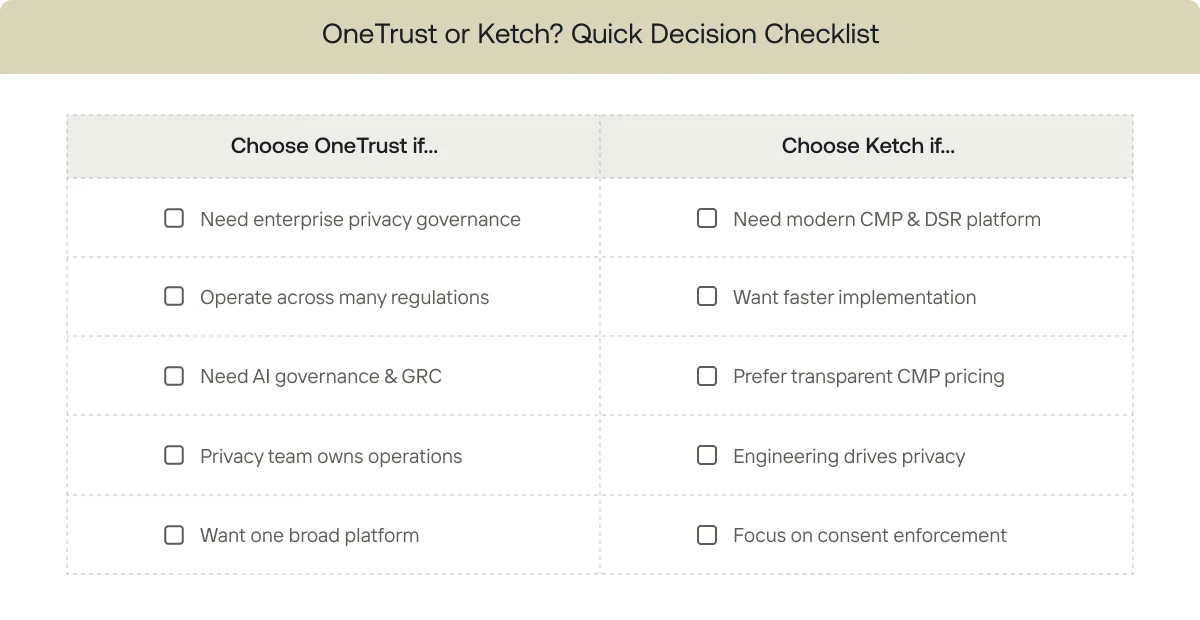
Despite Ketch's strengths in operational privacy, OneTrust remains the stronger choice for organizations with broad governance requirements.
You need a unified governance platform: OneTrust goes beyond consent management and privacy automation to include capabilities such as AI Governance, Third-Party Risk Management, Data Governance, and Tech Risk & Compliance. Organizations looking to consolidate multiple governance functions under a single platform may find OneTrust's broader product portfolio a better fit than point solutions.
You operate across multiple jurisdictions: OneTrust's DataGuidance platform tracks regulatory developments across 300+ jurisdictions and 50+ regulatory frameworks, helping privacy teams stay current with evolving requirements. For multinational organizations managing compliance across regions, this regulatory intelligence can reduce the effort required to monitor and interpret new privacy laws.
Your privacy team owns day-to-day operations: OneTrust is designed for privacy, legal, and compliance teams that manage consent, assessments, data mapping, and governance workflows through a centralized interface. While developer support may still be needed for some integrations, most day-to-day privacy operations can be managed through configurable workflows rather than custom engineering.
Where Ketch wins
Ketch stands out for organizations that want to operationalize privacy across their technology stack without the complexity of a broader governance platform.
Engineering teams are closely involved in privacy: Ketch's API-first architecture is built to integrate consent and privacy controls directly into applications and data infrastructure. Organizations with dedicated engineering resources can automate consent propagation and data rights workflows across connected systems instead of relying primarily on browser-side enforcement.
Faster deployment is a priority: Customer feedback consistently highlights Ketch's implementation experience. On G2, Ketch scores higher than OneTrust for Ease of Setup (8.5 vs. 7.8), Ease of Use (8.7 vs. 8.2), and Ease of Administration (8.8 vs. 8.4). Combined with transparent CMP pricing, this makes Ketch particularly attractive for mid-market organizations looking to deploy quickly without committing to a large, modular platform.
You're replacing only your CMP or preference management solution: Organizations that are satisfied with their existing governance tooling but want to modernize consent management can migrate to Ketch without replacing their entire privacy stack. Ketch runs a dedicated migration program for teams coming off other CMPs, so replacing consent and preference management doesn't mean rebuilding the rest of the privacy program.
What neither OneTrust nor Ketch covers
Choosing between OneTrust and Ketch isn't necessarily an either-or decision. Many privacy teams continue using their existing Consent Management Platform while adding tools that solve the gaps a CMP isn't designed to address.
Both OneTrust and Ketch help organizations collect and manage consent, automate privacy requests, and maintain compliance records. What they don't do is continuously verify whether consent is actually being enforced across live websites and mobile apps after deployment.
That distinction matters because websites and apps change constantly. New marketing tags, SDKs, third-party scripts, and product releases can introduce privacy risks long after a consent banner has been configured. Without continuous monitoring, these issues often remain undetected until a customer complaint, audit, or regulatory inquiry.
Privado AI is built to close that gap. It operates as a compliance verification layer that sits alongside existing consent management platforms (including OneTrust and Ketch) and continuously scans live digital properties to confirm that consent is being honored in practice.
Four capabilities are relevant here:
- Web Auditor: Scans live websites across 35+ locations, simulating each consent banner action (accept, reject, no action) and flagging non-compliant third-party data flows. No integration required.
- App Auditor: Scans iOS and Android app files for consent banner compliance, SDK data flows, and third-party data sharing. No technical implementation required.
- Agentic Assessments (powered by Wren): Uses AI agents to populate PIAs, DPIAs, and RoPAs by analyzing documentation, contracts, and data flows, which reduces manual questionnaire work.
- Dynamic Data Maps: Builds data maps by scanning code, websites, mobile apps, and contracts. Populates RoPAs automatically.
Privado AI also integrates with OneTrust, so data maps, assessments, and risks in OneTrust can be automatically updated from Privado AI scans.
Whether you choose OneTrust or Ketch, verifying compliance doesn't stop after implementation. Request a free website privacy audit to identify privacy risks across your live digital properties.
Legal disclaimer: This article is for informational purposes only and does not constitute legal advice. GDPR interpretation, enforcement, and application vary by jurisdiction and by processing activity. Consult qualified counsel for guidance specific to your organization.
FAQs
Is OneTrust better than Ketch?
OneTrust is better than Ketch if you need a broad privacy management platform with AI governance, third-party risk management, and regulatory intelligence. Ketch is a better choice for organizations prioritizing consent management, developer-friendly workflows, faster implementation, and transparent CMP pricing.
Is OneTrust worth the cost?
OneTrust can be worth the cost for large enterprises that need multiple privacy and governance capabilities in one platform. For mid-market teams or organizations that primarily need consent and preference management, the $10,000/year minimum and additional module costs may be difficult to justify.
Does Ketch support GDPR and CCPA compliance?
Yes. Ketch supports GDPR, CCPA, and other major privacy regulations through features such as consent management, data subject request (DSR) automation, preference management, Google Consent Mode v2, and IAB TCF support. Organizations with broader governance requirements may still need additional privacy tools.
Is switching from OneTrust to Ketch difficult?
Switching from OneTrust to Ketch is generally straightforward for organizations replacing only their consent management platform. Ketch offers migration support through Ketch Switch, although the overall migration effort depends on your existing integrations, workflows, and privacy program.
How much does OneTrust cost compared to Ketch?
OneTrust contracts start at a $10,000 annual minimum, with mid-market deployments running $40,000–$120,000 a year and enterprise deployments reaching $120,000–$500,000+. Ketch offers a free tier and published pricing tiers for smaller deployments, with custom enterprise pricing for larger organizations. Ketch generally provides more predictable pricing for mid-market teams.
What are the best alternatives to Ketch?
Some of the best Ketch alternatives include OneTrust for enterprise privacy management, Transcend for API-first privacy automation, Usercentrics and Cookiebot (now part of Usercentrics) for consent management, Osano for mid-market privacy compliance, and Privado AI for continuous website and mobile app privacy auditing, agentic assessments, and dynamic data mapping.
Industry insights you won’t delete. Delivered to your inbox.
Get regular updates from Privado AI
Request free website audit
Request Privado AI demo
Share
Author
.webp)