How to comply with new rules for privacy assessments, automated decisionmaking, & cybersecurity audits
Thank you!
Please check your email to view the guide.
OneTrust pricing: How much does it cost in 2026, and is it worth it?
August 31, 2026
5
mins read
Author


Unlike typical SaaS platforms with fixed public tiers, OneTrust uses a custom, sales-only model where your price depends entirely on how much web traffic you have and which specific tools you need to buy.
That's why two organizations buying the same platform can end up paying vastly different amounts. One may only need consent management for a handful of websites, while another is deploying privacy automation, third-party risk management, AI governance, and compliance workflows across multiple business units.
Since OneTrust doesn't publish official pricing, we used implementation and cost insights from Forrester's Total Economic Impact™ study, OneTrust's own documentation, verified customer reviews from G2, Gartner Peer Insights, and independent industry research.
Recorded OneTrust contracts range from a $10,000 annual minimum, in effect since Q2 2026, to $200,000 to $300,000 or more for multinational deployments. Forrester's Total Economic Impact™ study models a composite organization at $15 billion in revenue paying $292,000 a year for the platform.
This article explains how OneTrust pricing works, what drives costs, where hidden expenses appear, and whether the platform delivers enough value to justify its investment.

How OneTrust pricing is structured?
The table below shows how OneTrust groups its products for pricing and the primary metrics used to determine licensing.
While OneTrust markets its platform across solution areas including Consent & Preferences, Privacy Automation, Tech Risk & Compliance, Third-Party Management, AI Governance, and Ethics & Compliance (along with ESG & Sustainability solutions), commercial proposals are generally structured around five core pricing categories rather than these marketing groupings.
Each category operates on its own distinct metering metric, which means adding cross-functional capabilities immediately alters the architecture of your quote.
Source: OneTrust Pricing on Website
Pricing for these categories is provided through a custom quote based on the products selected, the applicable licensing metrics, implementation scope, and commercial negotiations.
What determines your OneTrust pricing?
Every OneTrust proposal is customized based on your organization's privacy program, deployment scope, and the products you choose.
That's why comparing OneTrust pricing between companies can be misleading. Two organizations may both purchase Consent & Preferences, for example, but if one manages a single website and the other supports hundreds of digital properties across multiple regions, their costs will be very different.
The table below outlines the main factors that influence your OneTrust cost.
Pricing varies considerably because every deployment is quoted individually.
Understanding the licensing metrics behind your quote is often more valuable than comparing publicly reported contract values. How an organization uses OneTrust often has a greater impact on pricing than its employee count.
A company deploying cookie consent for a handful of websites will typically have very different licensing requirements than an enterprise rolling out privacy automation, vendor risk management, and AI governance across multiple business units.
The hidden costs of OneTrust
The software license is only one part of the total investment. Depending on the products you purchase and the complexity of your deployment, additional costs can significantly increase the overall OneTrust cost.
Implementation and professional services
Many organizations require implementation services to configure workflows, integrate business systems, migrate data, and deploy the platform across multiple teams. These services are typically quoted separately from the software license, and the effort required depends on the size and complexity of the implementation.
In numbers, implementation, configuration, and ongoing support can represent 20%–40% of total contract value. Forrester's Total Economic Impact™ study found that the representative enterprise in its analysis spent a one-time $200,000 on implementation services, on top of the software licensing costs.
Ongoing administration
OneTrust is designed for enterprise privacy programs, which means someone has to maintain it.
As privacy regulations evolve and the business grows, teams spend time updating assessments, managing data maps, reviewing vendors, maintaining workflows, and onboarding new users. These operational costs aren't reflected in the initial proposal but should be considered as part of the total cost of ownership.
Licensing growth
Several OneTrust products are licensed using metrics such as Average Daily Unique Visitors (ADUVs), admin users, vendor inventory, or privacy assets. As those metrics increase, organizations may need to expand their licenses or renegotiate their contracts during renewal.
Because OneTrust licenses different products using different usage metrics, costs can increase even if you don't purchase additional modules. Growth in website traffic, vendor inventory, or privacy assets can all affect renewal pricing.
.webp)
Support and additional services
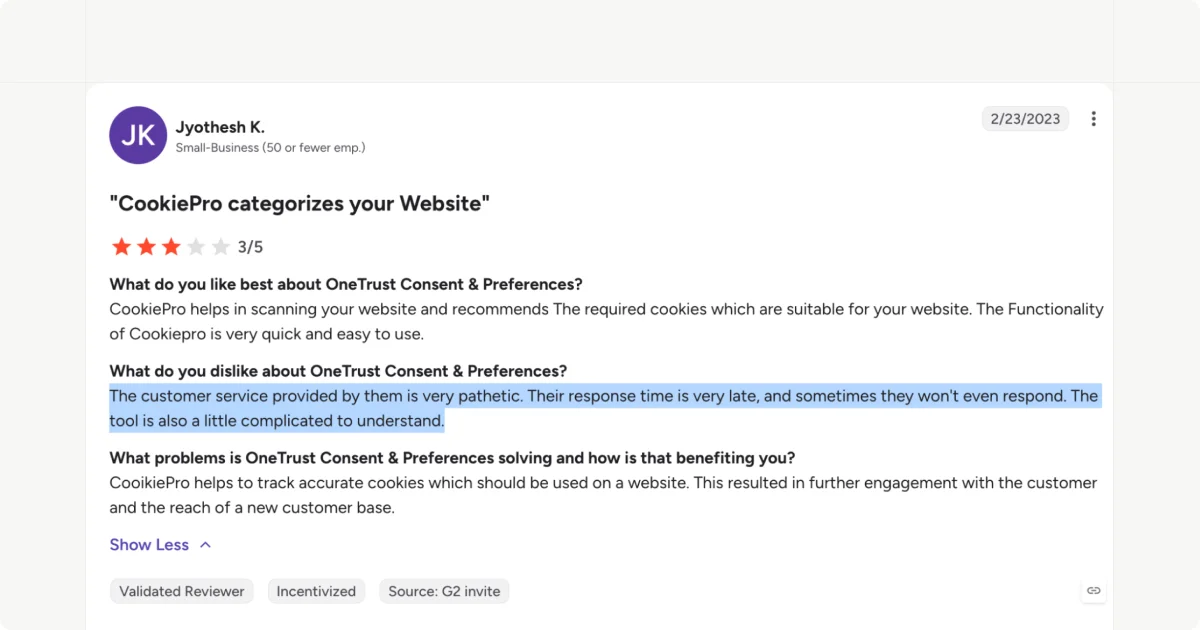
Standard support is included, but multiple reviewers describe it as limited. One G2 reviewer called the customer service "very pathetic," noting that response times are slow and sometimes there's no response at all.
Annual price escalation clauses
OneTrust contracts typically include an annual price hike that quietly compounds over time. Over a standard three-year term, this escalation alone can add up significantly to your total cost of ownership. And that's the standard clause. One reviewer reported receiving 275% and 468% price increases with very short notice.
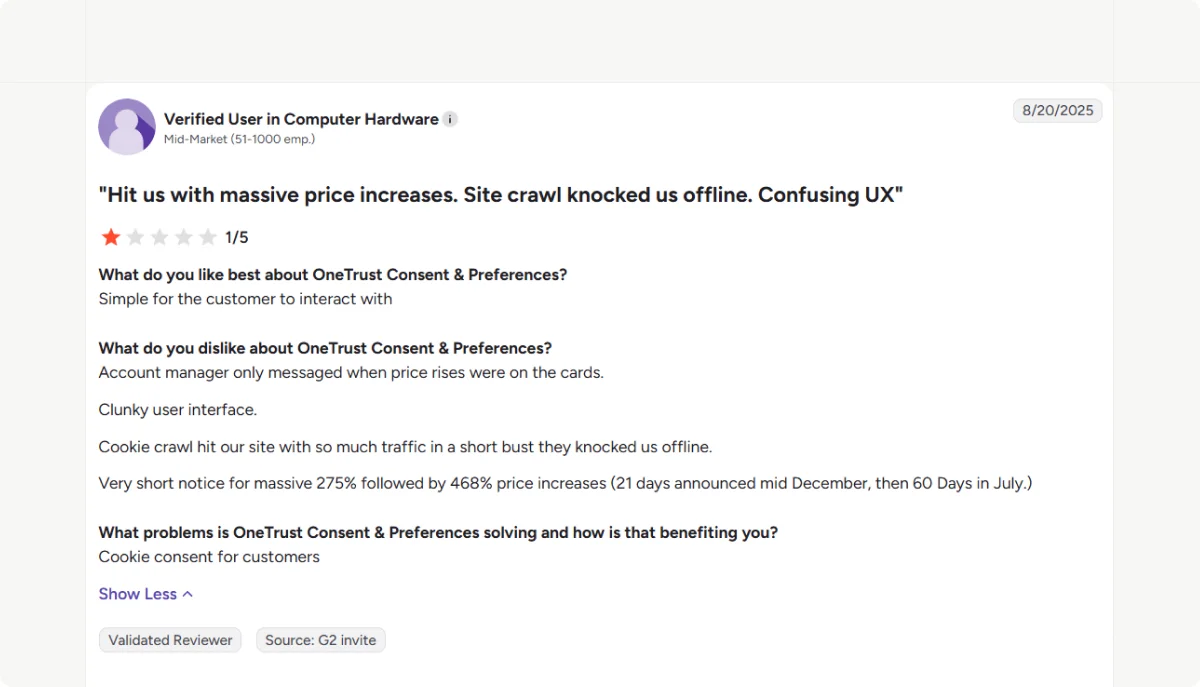
These cases appear tied to OneTrust's shift from per-domain to traffic-based pricing, but they illustrate how unpredictable renewals can be if escalation terms aren't negotiated upfront.
Training and adoption
OneTrust has a steep learning curve, and that translates into real cost even when the training itself is free. Multiple G2 reviewers note that the platform can be overwhelming to implement and navigate, especially for smaller teams, and that configuring automation rules and integrating with internal systems requires technical expertise or consulting support.
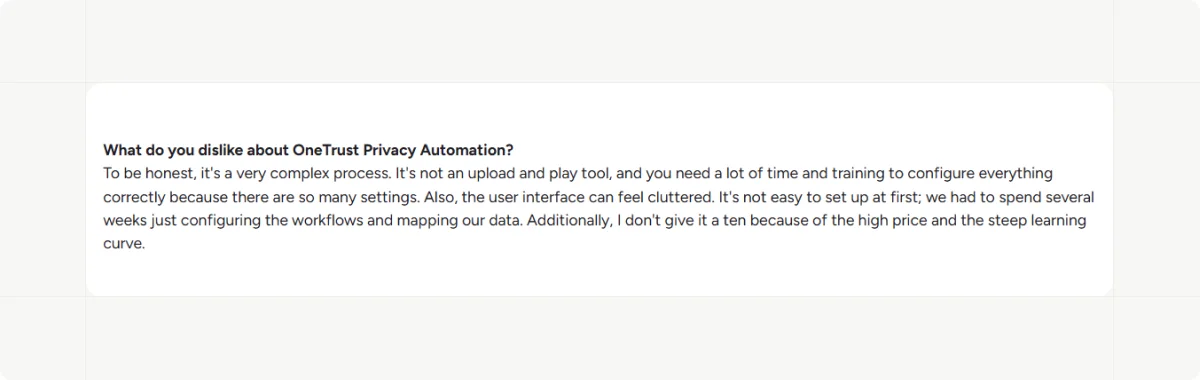
For privacy teams that are already stretched thin, the hours spent learning and maintaining the platform are hours not spent on actual privacy work.
Is OneTrust worth it? An honest verdict
OneTrust covers more of the privacy stack than any single-purpose tool: consent, privacy operations, third-party risk, and AI governance in one contract.
For organizations running mature privacy programs across multiple business units and jurisdictions, bringing consent management, privacy operations, third-party risk, AI governance, and compliance workflows into a single platform can simplify day-to-day operations.
Consider OneTrust if...
Your organization operates across multiple jurisdictions and needs to manage privacy beyond cookie consent alone. Enterprises that require privacy automation, governance workflows, vendor risk management, and AI governance in one platform are likely to benefit most from OneTrust's breadth.
It's also a strong choice for organizations with dedicated privacy, legal, and IT teams that can support implementation and ongoing administration.
Avoid OneTrust if...
If your primary requirement is deploying a consent banner or managing compliance for a handful of websites, OneTrust may offer more functionality than you need. Smaller organizations can find the platform expensive to implement and maintain compared to simpler consent management solutions.
Similarly, teams without a dedicated privacy team should consider the operational effort required to configure and manage an enterprise platform over time.
OneTrust is a powerful platform, but the best choice depends on the maturity of your privacy program rather than the size of your budget. Before making a decision, evaluate whether you'll actively use the broader capabilities included in your proposal. For many organizations, the biggest driver of ROI isn't the license itself, but how much of the platform they actually adopt.
That tradeoff is reflected in broader market sentiment. According to Assemble's 2026 Data Privacy Technology & Vendor Decisions report, OneTrust remains the dominant privacy platform with 83% adoption among surveyed organizations, but the average recommendation score is only 5.2 out of 10, suggesting that many teams continue using the platform despite mixed satisfaction with implementation, pricing, and usability.
| Related Read - 13 Best OneTrust Competitors and Alternatives in 2026
Why collecting consent isn't the same as verifying compliance?
Pricing is only one part of evaluating a consent management platform. It's equally important to understand what a consent management platform is designed to do and where additional privacy controls may be needed as your compliance program matures.
A recent Privado AI study of the top 250 websites by traffic across California, France, and the UK found that 90% failed at least one privacy compliance test under the California Consumer Privacy Act (CCPA) or the General Data Protection Regulation (GDPR). Many of those organizations already had a consent management platform in place. The challenge wasn't collecting consent. It was continuously verifying that consent was being enforced across live environments.
Assemble's 2026 Q1 benchmark found that 95% of surveyed privacy leaders use OneTrust for consent management, yet the average recommendation score was just 4.7/10, highlighting how widespread adoption doesn't necessarily translate into satisfaction.
This is why many organizations use Privado AI alongside OneTrust, rather than instead of it. OneTrust helps organizations collect and manage consent, while Privado AI continuously verifies what's actually happening across live websites, mobile apps, source code, and SaaS applications. It automatically discovers data flows, identifies privacy risks, and provides evidence that complements existing privacy workflows instead of relying solely on manual inputs.
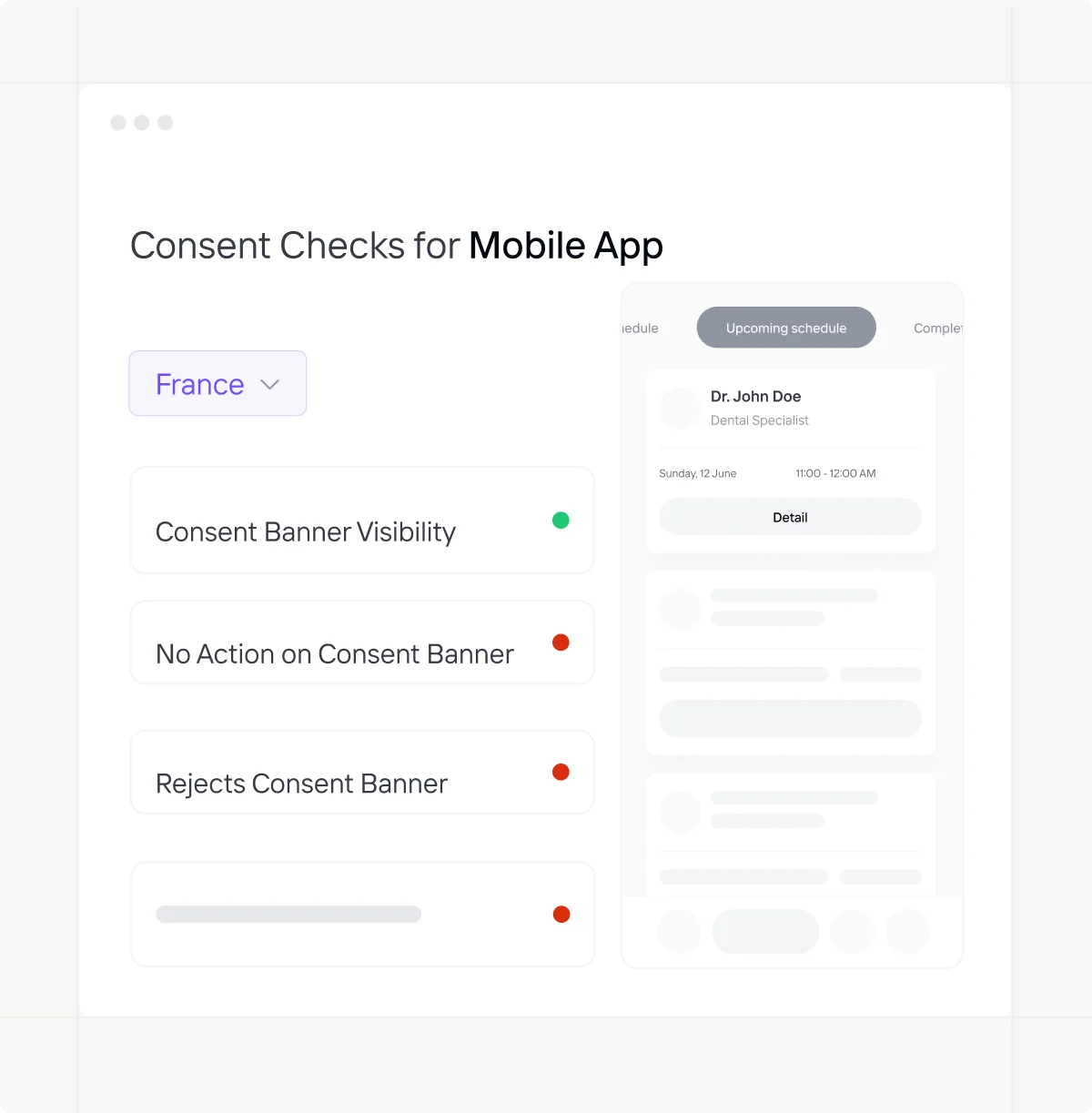
Continuous monitoring helps close that gap by verifying that:
- Consent banners display correctly across jurisdictions.
- Third-party scripts and SDKs respect user consent before collecting data.
- Personal data is shared only when permitted by applicable privacy laws.
- New privacy risks are identified quickly so they can be remediated before they become enforcement issues.
Together, OneTrust and Privado AI help privacy teams move beyond documenting compliance to continuously validating it across their digital ecosystem.
Why privacy teams pair Privado AI with OneTrust?
OneTrust provides a foundation for consent management, privacy operations, and AI governance. Privado AI complements it by continuously supplying verified technical evidence that keeps OneTrust records accurate and up to date, without replacing existing workflows.
Web Auditor continuously scans live websites to identify consent failures, unauthorized data sharing, misconfigured tags, and privacy violations.
.webp)
App Auditor extends the same visibility to mobile apps by identifying SDKs, trackers, and data flows that may not align with declared privacy practices or consent requirements.
Wren, Privado AI's AI privacy analyst, automatically gathers technical evidence to support Privacy Impact Assessments (PIAs), Data Protection Impact Assessments (DPIAs), Transfer Impact Assessments (TIAs), and Records of Processing Activities (RoPAs), reducing the reliance on manual questionnaires.
.webp)
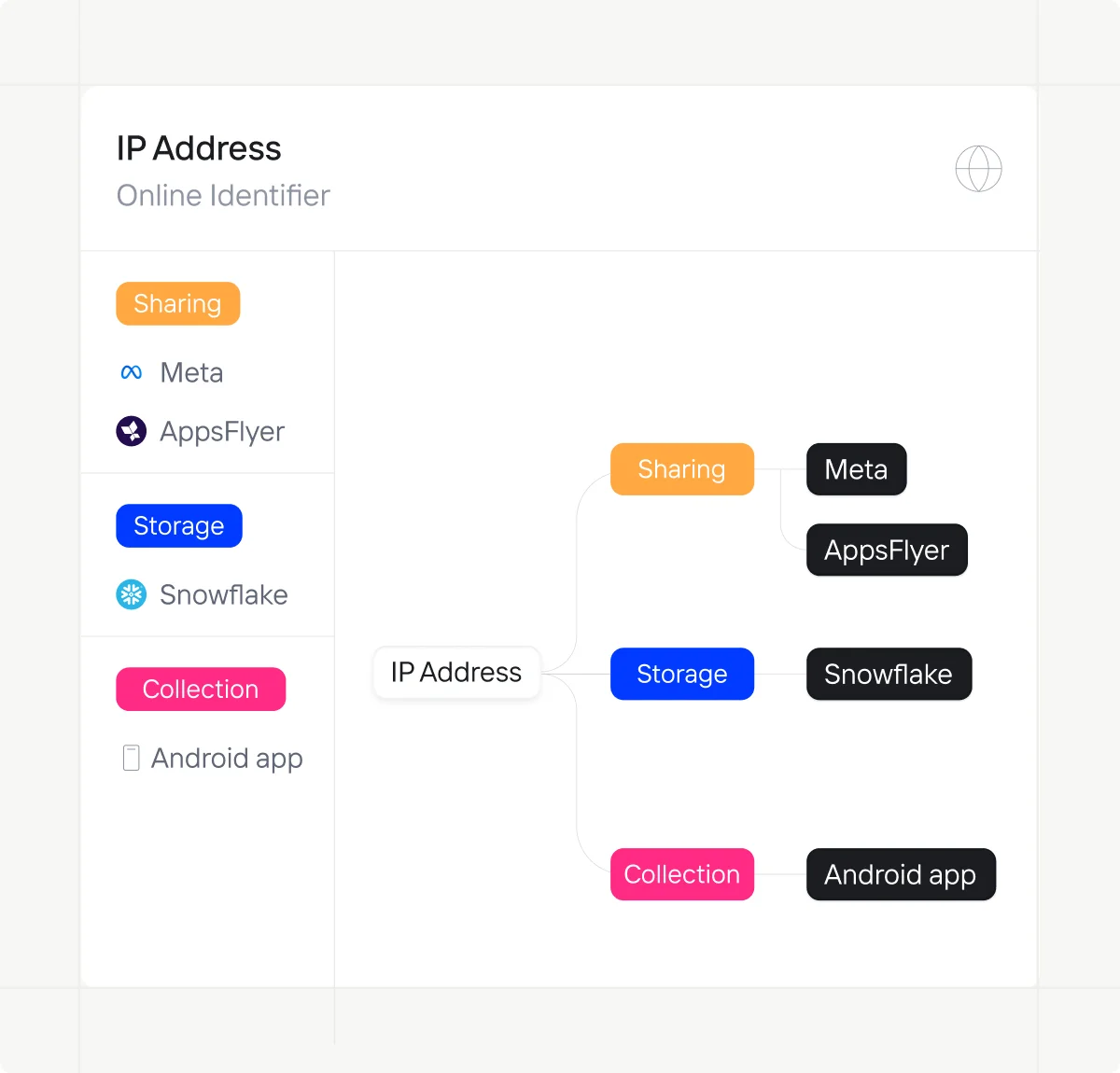
Dynamic Data Maps continuously discover data flows across source code, websites, mobile apps, and Software-as-a-Service (SaaS) applications, helping keep OneTrust inventories synchronized with production environments.
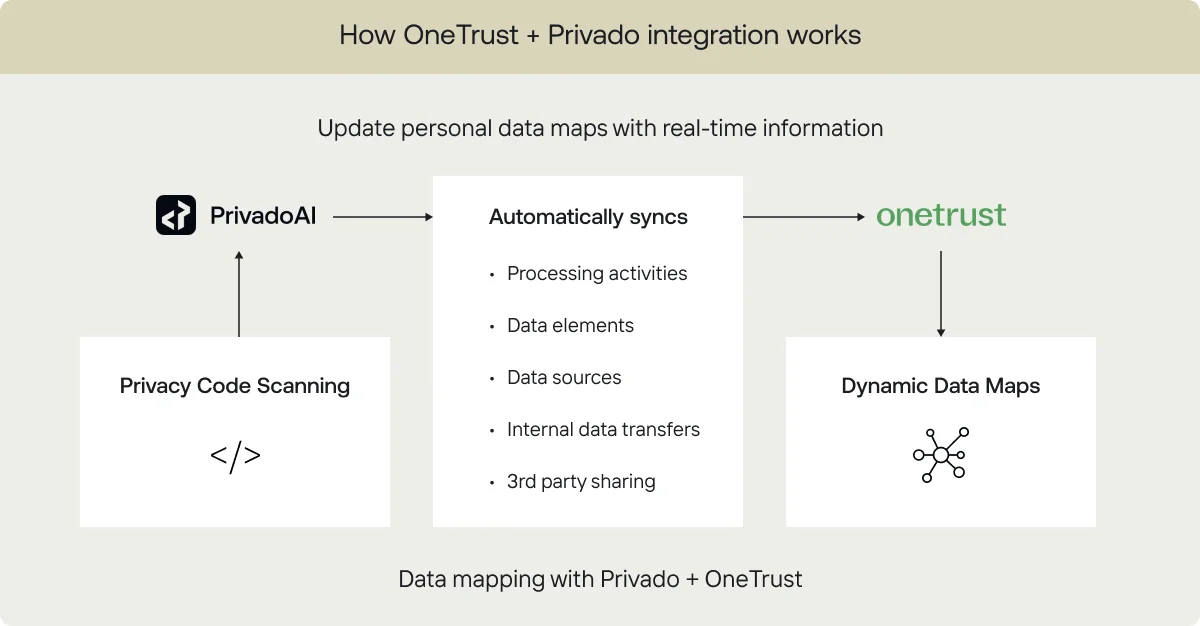
None of this needs to live in a separate system. Privado AI's OneTrust integration syncs data elements, processing activities, vendors, and auto-generated data flow diagrams directly into OneTrust's data inventory, updating automatically whenever the underlying code changes.
Whether you're evaluating OneTrust pricing for the first time or renewing an existing contract, pairing it with Privado AI gives you continuous technical validation alongside OneTrust's governance workflows.
Run a free website scan to see how your live website performs against GDPR, CCPA, CIPA, VPPA, and other privacy requirements.
Notice: This article is for informational purposes only and does not constitute legal or procurement advice. Pricing figures are third-party reports and estimates, not published OneTrust rates, and will vary by deployment. Verify current terms directly with the vendor.
FAQs
Is OneTrust free?
No, OneTrust is not free. OneTrust is an enterprise software platform that uses custom pricing and does not offer a free plan. Organizations receive a quote based on the products they license, the size of their deployment, and other pricing factors such as website traffic, admin users, or vendor inventory.
Who competes with OneTrust?
OneTrust competes with several privacy and consent management platforms, including TrustArc, Ketch, Usercentrics, Osano, Transcend, Didomi, Sourcepoint, and Cookiebot. The right alternative depends on your requirements. Some platforms focus primarily on consent management, while others offer broader privacy operations, data mapping, assessments, or AI governance capabilities.
What is the open source alternative to OneTrust?
There is no direct open-source alternative that matches OneTrust's full privacy platform. However, organizations looking for open-source consent management tools often evaluate solutions such as Klaro! for cookie consent. These tools can help with consent collection but typically don't include enterprise features like privacy assessments, vendor risk management, data mapping, or AI governance.
How long does OneTrust take to implement?
How long OneTrust takes to implement depends on the products being deployed and the complexity of the organization. A basic consent management implementation can be completed relatively quickly, while enterprise deployments involving Privacy Automation, Third-Party Management, AI Governance, and integrations with existing business systems can take several weeks or months.
Industry insights you won’t delete. Delivered to your inbox.
Get regular updates from Privado AI
Request free website audit
Request Privado AI demo
Share
Author
.webp)