
How to comply with new rules for privacy assessments, automated decisionmaking, & cybersecurity audits
Thank you!
Please check your email to view the guide.
Why Google Consent Mode Is Now a Bigger Compliance Risk for Websites
July 17, 2026
5
mins read
Author


A visitor rejects tracking on a website or sends a Global Privacy Control opt-out, yet data can still continue flowing to Google Ads. Privado AI’s pre- and post-June 15 comparison shows the issue did not improve after the change.
Across the same 250 websites, CCPA failures rose from 81% to 87%, GDPR reject-all failures rose from 52% to 56%, and fully compliant sites dropped from 14% to 10%. This makes Google Consent Mode misconfiguration an active risk rather than a one-time snapshot.
Privado AI’s scan, run on June 16, 2026, tested top websites across California, France, and the United Kingdom. This blog explains the June 15 Google change, key findings, and checks to help reduce risk under the California Consumer Privacy Act (CCPA) and the General Data Protection Regulation (GDPR).

What changed with Google Consent Mode on June 15, 2026?
On June 15, 2026, Google removed the Google Analytics setting that limited personal data sent to Google Ads for cross-device remarketing. This made Google Consent Mode the primary control for limiting personal data sent to Google Ads.
Before this change, some companies used Google Analytics settings as a secondary privacy control. After the change, if a Google Consent Mode misconfiguration exists, a website may send the full signal to Google Ads even when the user rejects tracking or sends an opt-out signal.
Consent enforcement now depends on how a website detects privacy signals, translates them into Consent Mode values, and applies those values across downstream technologies. This is why consent compliance monitoring has become a larger operational priority for privacy teams.
Did website compliance improve after the June 15 change?
No. Privado AI scanned the same 250 websites on June 11 and June 16, 2026. The results showed almost no improvement in the Google Consent Mode layer and weaker outcomes in the broader consent compliance layer.
The clearest shift appeared in broader compliance outcomes. CCPA failures increased, GDPR reject-all failures increased, and the share of fully compliant websites fell after the June 15 change.
This comparison strengthens the core finding: Consent Mode risk is not static. Without active validation, website updates and tag changes can allow consent enforcement to degrade over time.
What did Privado AI's report reveal about Google Consent Mode failures?
Privado AI scanned the top 250 websites by traffic across California, France, and the United Kingdom. The scan tested whether privacy choices translated into Google Consent Mode signals and whether consent was enforced across tracking technologies.
These findings show that Google Consent Mode can fail even when a website has visible consent controls. That gap is why digital tracking governance matters for privacy teams that need to verify actual tracking behavior.
How did Privado AI test Google Consent Mode compliance?
Privado AI’s Web Auditor simulated real user sessions across California, France, and the UK. The tests covered Consent Mode parameters, GPC opt-out sessions, reject-all sessions, and sessions where no consent action was taken.
For each session, the system recorded cookies, network requests, and vendor behavior under conditions of denied consent. The methodology focused on observable website behavior that privacy teams, auditors, regulators, and plaintiffs could review.
- Tested Consent Mode defaults before any user interaction, tracking whether sites started in granted or denied states
- Simulated reject-all behavior on European sites to check whether downstream Google signals changed after refusal
- Checked GPC opt-out handling in California to verify whether browser signals are mapped to denied consent
- Reviewed cookies, tags, pixels, and network requests that continued operating under denied consent conditions
Why does a Google Consent Mode misconfiguration matter?
A Google Consent Mode misconfiguration creates a gap between what the visitor chooses and what the website does. That gap can create exposure under CCPA, GDPR, UK GDPR, PECR, and related ePrivacy rules.
In California, the risk centers on GPC opt-out signals that are not translated into denied Consent Mode values. Enforcement patterns under CCPA have already reached companies across retail, healthcare and media, with settlements running into millions of dollars.
In Europe, the risk centers on tracking that fires before valid consent is received or after users reject cookies. Regulators enforcing GDPR and ePrivacy rules have repeatedly cited pre-consent tracking and weak reject-all handling in recent actions.
Why consent collection is not the same as consent enforcement?
A consent banner records a choice. It does not prove enforcement across the wider tracking stack.
Collecting a preference and enforcing that preference are two different technical activities. A Consent Management Platform can display the banner correctly while advertising pixels, analytics tags, and downstream scripts continue processing data in ways that conflict with the recorded choice.
The gap sits between the banner and the tags. Verifying enforcement requires testing what happens after the user clicks reject or sends a GPC signal. Consent compliance monitoring closes that gap by observing real downstream behavior across every tag, cookie, and network request.
What are the most common Google Consent Mode failures?
The report highlights three recurring failure points in Google Consent Mode. Each creates a different operational risk for privacy teams because the banner, the browser signal, and the downstream Google signal may not align.
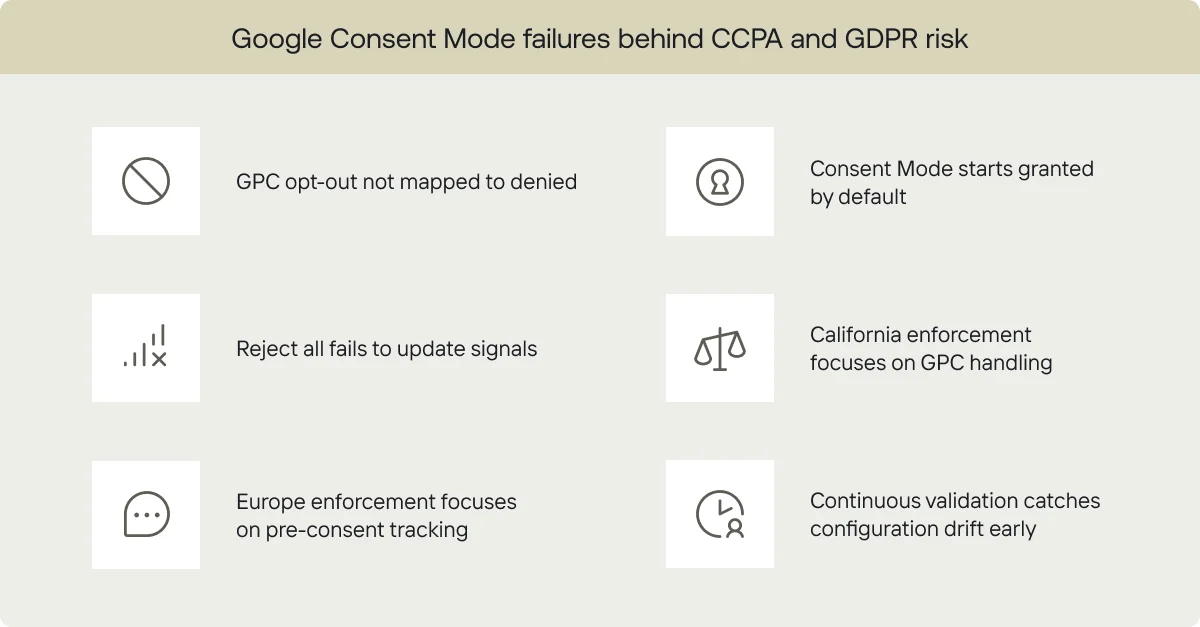
GPC opt-out is not mapped to denied consent
Global Privacy Control is a browser-level opt-out signal that California recognizes for CCPA opt-out requests. When the browser sends GPC, the website is expected to translate that signal into denied Consent Mode values for Google.
The report found that 40% of tested California websites kept Google Consent Mode in a granted state after a GPC opt-out. Data continued to flow to Google Ads for cross-device remarketing after the user had already opted out in the browser.
Consent Mode starts as granted by default
In Europe, Google Consent Mode should initialize in a denied state until valid consent is collected from the user. Denied defaults prevent tracking before the visitor engages with the consent banner or takes any privacy action.
The report found that 28% of tested European implementations initialized Consent Mode in a granted state by default. Data flowed to Google Ads at page load, before the user had any chance to accept or reject tracking.
Reject all that does not update Google Consent Mode
Some consent banners record a reject-all action locally but never update the downstream Google Consent Mode values to denied. The banner UI reflects rejection, yet Google continues receiving granted signals.
The report found that 19% of tested European websites showed this pattern. Users saw a working reject-all button, while Google Ads continued receiving the full signal for advertising and cross-device remarketing purposes.
How do CCPA and GDPR consent failures differ?
CCPA and GDPR create different operational failure points for Consent Mode. California enforcement focuses on whether browser-level opt-out signals like Global Privacy Control are honored across downstream tracking technologies.
European enforcement focuses on tracking that fires before valid consent is received and on reject-all actions that fail to stop non-essential tracking. Companies often build consent infrastructure for GDPR opt-in requirements but fail to extend it to CCPA opt-out signals.
The two regimes are not interchangeable. A website can pass one and fail the other, which is exactly what the report data shows across the tested sample.
What broader consent compliance failures did Privado AI find?
Google Consent Mode is one layer of consent compliance. Privado AI's broader study looked at all cookies, tags, and tracking technologies to see whether user choices were enforced across the wider stack.
Which industries showed higher Google Consent Mode risk?
Privado AI found that Google Consent Mode risk varies by industry. Some sectors showed elevated failure rates across the GCM layer, while others appeared cleaner on GCM yet still failed broader consent enforcement tests.
A lower Google Consent Mode failure rate does not automatically mean lower privacy risk. Some industries with cleaner Consent Mode setups still showed high broader consent enforcement failures across CCPA and GDPR checks.
Why do Google Consent Mode failures happen?
Google Consent Mode failures usually happen when teams treat consent as a one-time banner implementation rather than an ongoing enforcement system. The report identifies recurring causes linked to consent interpretation, regional configuration, default states, and tracking changes.
- Consent collection is mistaken for consent enforcement, so downstream tags keep processing data after opt-out actions
- GDPR opt-in infrastructure is not always extended to California GPC and CCPA opt-out workflows in practice
- Incorrect Consent Mode defaults can allow tags to fire before valid consent has been given
- Marketing tags, vendors, scripts, and containers change often, causing configuration drift after deployment
The common thread is visibility. Most teams cannot easily see how consent signals translate across vendors and tags after deployment, and small changes accumulate over time.
.webp)
What do compliant Google Consent Mode implementations have in common?
The websites that passed testing shared practical control patterns. These controls should be treated as implementation checks for privacy, legal, marketing operations, and analytics teams, not as standalone legal advice.
How should companies test Google Consent Mode after the June 15 change?
The June 15 change raised the stakes on Google Consent Mode misconfiguration. Privacy, legal, marketing operations, and analytics teams can run the following checks to identify the most common issues.
- Verify Consent Mode defaults before any non-essential cookies, pixels, analytics requests, or ad tags load.
- Validate reject-all behavior by checking whether Google and downstream vendors stop receiving data.
- Test GPC directly in California and confirm that the signal changes downstream Google consent states.
- Inventory denied-state activity across tags, cookies, network requests, and third-party destinations.
- Monitor continuously after website updates, campaign launches, vendor additions, and tag manager changes.
Testing once is not enough because websites change. New scripts, tag manager updates, and vendor changes can create a fresh Google Consent Mode misconfiguration after deployment.
.webp)
How does Privado AI detect Google Consent Mode misconfigurations?
Privado AI is an Agentic privacy platform, not only a consent scanning tool. The platform combines live website testing, mobile app testing, agentic assessments and dynamic data mapping to reduce compliance risk across the business.
The Web Auditor scans live websites to verify Consent Mode behavior, GPC handling, reject-all enforcement, pre-consent tracking, pixels, cookies and network requests. It flags each failure with the specific tag, vendor, and request involved so that teams can remediate the exact issue quickly.
The App Auditor checks mobile app SDK behavior and tracking activity across iOS and Android after every release. Wren automates assessment workflows from intake through risk tracking. Dynamic Data Maps update from code, SaaS integrations, web scans, and app audits, giving privacy teams a live view of data flows.
Privado AI works alongside existing CMPs. Privacy teams do not need to switch consent platforms to gain enforcement visibility across web and mobile. That makes deployment fast and reduces friction with marketing and engineering owners.
Scan your website with Privado AI to verify whether consent choices are enforced.
Where does Google Consent Mode fit into broader privacy risk management?
Google Consent Mode is one control in a larger privacy risk system. Privacy teams need visibility across data maps, privacy assessments, app SDK audits, web tracking behavior, and developer remediation workflows.
Treating Consent Mode as a standalone project misses the wider picture. The same signals that break Consent Mode often break other tracking behaviors, creating parallel exposure across the site and app estates.
Product privacy management frames Consent Mode as one output of a broader system. Privacy teams gain leverage when they integrate consent enforcement with data mapping and assessment workflows into a single operating model.
Where can teams read the full report?
The State of Google Consent Mode report includes the full methodology, the Google Consent Mode findings, the broader consent compliance results, and the industry breakdown. It also compares scan results before and after the June 15 change.
The report covers legal risk context under CCPA and GDPR, the recurring failure causes identified in the dataset, and the recommended next steps for privacy teams. Every finding maps to a specific observable test on a live website.
Download the full report to see how top websites are failing Google Consent Mode, GPC, reject-all, and broader consent compliance tests.
As covered by
Publications have covered Privado AI's report on the June 15 change and its compliance implications.
- Privado AI finds Google Consent Mode errors on 48% of sites - CMOtech UK, June 26, 2026
- Google Consent Mode Misconfigured on Nearly Half of Major Websites - iHal, June 24, 2026
- Google Consent Mode Change Risks Companies’ Privacy Compliance: Report - Privacy Daily, June 17, 2026
- Privado AI Finds Widespread Google Consent Mode Violations - MarTech Cube, June 17, 2026
FAQs
What is a Google Consent Mode misconfiguration?
A Google Consent Mode misconfiguration occurs when a website fails to translate a user's privacy choice into the correct Consent Mode signal. For example, a GPC opt-out from a California visitor may leave Consent Mode in a granted state. This creates a gap between the recorded choice and the enforced choice.
Is Google Consent Mode enough for privacy compliance?
Google Consent Mode alone is not enough for full privacy compliance. The Consent Mode layer must be configured correctly, tested against real user actions, and continuously monitored alongside broader consent enforcement checks. Cookies, pixels, and network requests all require verification in denied-consent states.
What is GPC in CCPA compliance?
Global Privacy Control is a browser-level opt-out signal that California recognizes for CCPA opt-out requests. When a visitor sends GPC, the website is expected to treat that as an opt-out of sale or sharing. The signal should map to a denied Google Consent Mode state for that visitor.
Why should Google Consent Mode start in a denied state?
A denied default state prevents data from flowing to Google before the visitor has given valid consent. This aligns with European expectations under the GDPR and ePrivacy rules, where non-essential tracking should not fire before opt-in. Granted defaults create pre-consent tracking risk on European sites.
How often should companies test consent compliance?
Companies should test consent compliance continuously or at every release cycle. Website updates, tag changes, campaign launches, container updates and vendor additions are all common trigger points. Consent configurations drift over time, so one-time audits miss regressions that appear between formal reviews.
Industry insights you won’t delete. Delivered to your inbox.
Get regular updates from Privado AI
Request free website audit
Request Privado AI demo
Share
Author
.webp)