How to comply with new rules for privacy assessments, automated decisionmaking, & cybersecurity audits
Thank you!
Please check your email to view the guide.
OneTrust vs Transcend: Which One Is the Best Choice in 2026?
August 13, 2026
5
mins read
Author


Privacy teams rarely replace an entire stack overnight. What’s more common is that one workflow starts slowing the team down. Maybe privacy requests are piling up. Maybe data maps are out of date the moment they’re published. Or maybe a consent platform is doing its job, but everything behind it still depends on spreadsheets, questionnaires, and follow-up emails.
That's why more privacy leaders are replacing individual tools instead of rebuilding their entire stack. According to the 2026 Decision Intelligence Benchmark from the Data Privacy Board, 42% of privacy leaders are planning selective replacements to their privacy tech stack, while 44% say efficiency and time savings are the biggest drivers behind technology decisions.
Two platforms that often come up during these evaluations are OneTrust and Transcend.
The overlap is real: both sell consent management and DSR automation to the same buyer. Both help organizations comply with privacy regulations, automate operational workflows, and reduce manual effort. But they take very different approaches.
OneTrust is a broad privacy management platform with modules for consent management, assessments, data mapping, third-party risk, and more. Transcend takes a narrower, engineering-first approach, focusing on automating data subject requests, consent, and privacy infrastructure through APIs.
So which privacy tool should you choose?
Choosing OneTrust or Transcend depends on what you're trying to solve. This guide breaks down the differences across features, pricing, implementation, and best-fit use cases.

What Is OneTrust?
.webp)
OneTrust is the leading choice in this category, with 49% of its G2 reviewers being enterprise buyers, the highest share of any privacy platform.
It offers products for consent management, data mapping, privacy impact assessments, third-party risk management, AI governance, and data subject request (DSAR) automation.
Many organizations adopt OneTrust because they want a single platform to manage multiple privacy workflows rather than stitching together separate tools.
Its cookie consent platform is particularly mature and has become the default choice for many enterprise compliance teams. Over time, many customers expand into additional modules such as assessments, data mapping, and third-party risk management.
That breadth is OneTrust's biggest strength. It's designed to support organizations with mature privacy programs that need centralized governance across multiple business units.
The trade-off is complexity. Because OneTrust covers so many workflows, implementation runs longer than with specialized tools, and teams often buy modules ahead of needing them. The switching cost is equally real: once legal and compliance processes are built around the platform, moving off it requires a data-backed business case, and the practical window is contract renewal.
What Is Transcend?
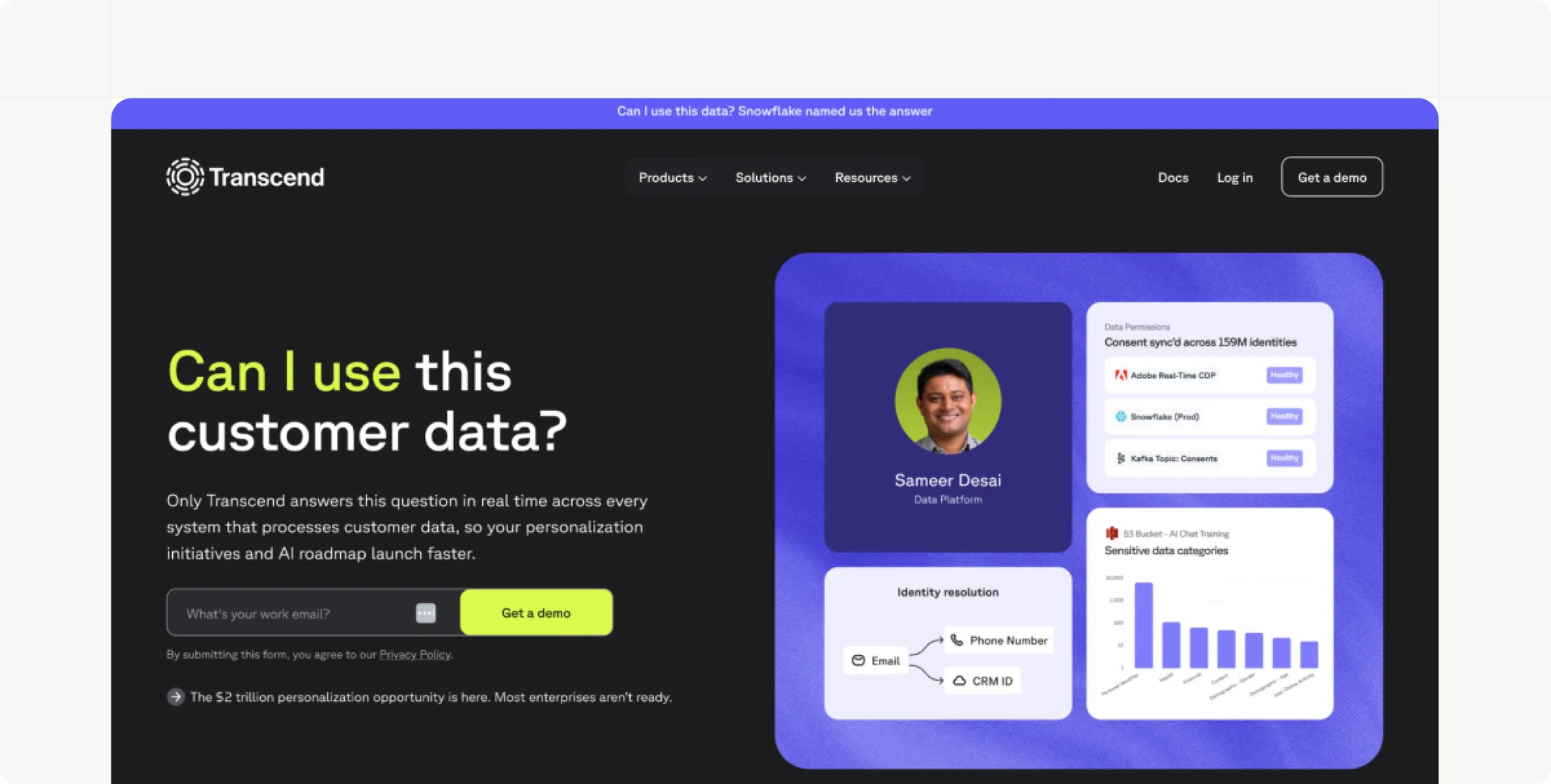
Transcend is a privacy infrastructure platform built around automation. Rather than offering a broad governance suite, it focuses on helping organizations automate consent management, privacy requests, and data operations across connected systems.
Transcend is best known for its Data Subject Access Request (DSAR) automation. It connects directly with SaaS applications and internal systems to process access and deletion requests with minimal manual work. The platform also offers consent management and preference management products that integrate into existing applications.
Because of its integration- and automation-focused approach, Transcend may appeal to engineering-led organizations that want privacy workflows connected directly to their existing systems. Compared with OneTrust, it places greater emphasis on automating operational workflows, while OneTrust offers a broader range of privacy governance, risk, and compliance capabilities.
OneTrust vs Transcend: Comparison Table
The table below summarizes the differences between OneTrust and Transcend before we dive into each capability in detail.
Consent Management: OneTrust vs Transcend
Consent management is one of the few areas where both Transcend and OneTrust offer mature capabilities. The biggest difference isn't the consent banner users see. It's what happens behind the scenes after someone updates their privacy preferences.
OneTrust follows a traditional consent management platform (CMP) model. It captures and stores user consent through its banner and applies those preferences within the OneTrust ecosystem. If you're also using OneTrust for data subject requests or other privacy workflows, those modules are configured separately. That gives organizations flexibility, but it also means consent enforcement across downstream systems depends on how those workflows are integrated.
Transcend approaches consent differently. Rather than treating consent as a browser-side event, it acts as a middleware layer that propagates consent signals across connected applications, databases, and vendors. When a user withdraws consent or changes their preferences, connected systems automatically receive the updated signal, helping to ensure those preferences are enforced consistently.
For organizations that primarily need a CMP backed by broader governance capabilities, OneTrust is a strong choice. Teams looking to automate consent enforcement across engineering systems may find Transcend's architecture a better fit.
Verdict:
OneTrust is a better fit for organizations looking for a mature consent management platform as part of a broader privacy governance suite.
Transcend is a better fit for teams that want consent preferences to automatically propagate across connected applications and systems without having to build custom workflows.
DSR Automation: OneTrust vs Transcend
Both platforms automate data subject requests (DSRs), but they take different approaches to getting there.
OneTrust provides configurable workflows for handling access, deletion, correction, and other privacy requests. Organizations connect business systems, define approval workflows, and configure how requests are fulfilled. This works well for enterprises that want extensive control over the process, but implementation can require significant setup depending on the number of systems involved.
DSR automation is where Transcend has built much of its reputation. The platform connects directly to SaaS applications, databases, and internal systems to automate request fulfillment with minimal manual intervention. Rather than routing requests between teams, it orchestrates the process across connected systems and maintains an encrypted audit trail throughout the request lifecycle.
For organizations handling a high volume of privacy requests, Transcend's automation-first approach can significantly reduce operational effort. OneTrust remains a strong option for enterprises that want DSRs as part of a broader governance platform rather than a standalone workflow.
Verdict:
OneTrust is a better fit if you want configurable DSR workflows alongside assessments, data mapping, and other privacy operations in a single platform.
Transcend is a better fit if your priority is automating high-volume privacy requests across connected systems with minimal manual effort.
Data Mapping: OneTrust vs Transcend
Data maps are the artifact auditors ask for first and the one most likely to be out of date. They support compliance activities ranging from Records of Processing Activities (RoPAs) and privacy assessments to DSRs and regulatory reporting.
OneTrust builds data maps through inventories, questionnaires, and stakeholder input. Business owners provide information about the personal data their systems collect, use, store, and share, and that information is consolidated into a central inventory. This approach gives privacy teams strong governance over documentation, but keeping those records current often depends on stakeholders updating information as systems change.
Transcend reduces that manual effort by discovering personal data across connected systems through integrations. It continuously syncs metadata from supported applications to keep inventories more up to date. This makes it well-suited for organizations with modern SaaS environments and mature engineering teams.
However, both approaches have blind spots. Connected-system discovery only reflects systems that have been integrated. The standard worth holding either platform to is replicability: can a privacy analyst manually reproduce any finding the tool reports? Connector-based discovery describes what a system says it holds. It doesn't verify what the application actually does.
For organizations focused on maintaining an accurate inventory across business systems, both platforms provide capable data mapping solutions. Teams that also need visibility into live website and mobile app behavior typically supplement their privacy stack with continuous web and app auditing.
Verdict:
OneTrust is a better fit for organizations that prefer governance-driven data mapping through inventories and stakeholder input.
Transcend is a better fit for teams that want to automatically discover and maintain data inventories across connected systems, reducing manual documentation.
Implementation: OneTrust vs Transcend
Implementation is often where the biggest differences between privacy platforms become apparent. While both OneTrust and Transcend require planning and stakeholder involvement, the amount of work needed to get each platform running is quite different.
OneTrust is designed as an enterprise platform with multiple products that can be deployed together or over time. That flexibility comes with additional configuration. Depending on the modules you purchase, implementation may involve configuring workflows, integrating business systems, migrating existing records, and training teams across legal, privacy, and IT.
Transcend takes a more focused approach. Because its products are built around APIs and pre-built integrations, implementation is generally faster for organizations with engineering resources. Rather than configuring a broad governance platform, teams connect their systems and begin automating workflows.
Beyond customer reviews, implementation cost is another consideration. Enterprise privacy teams evaluating OneTrust frequently mention that professional services and implementation consulting become a meaningful part of the overall project budget, especially when deploying multiple modules. Organizations should factor both software licensing and implementation services into their total cost of ownership.
Transcend's narrower product scope generally translates to a faster time to value, particularly for engineering-led organizations that already have the technical resources to connect systems and APIs.
Verdict:
OneTrust is a better fit for organizations that have the time and resources to implement a broad privacy governance platform across multiple business functions.
Transcend is a better fit for engineering-led teams looking for faster deployment and quicker time to value.
Pricing: OneTrust vs Transcend
When evaluating OneTrust vs Transcend, pricing is one of the hardest areas to compare because neither platform publishes standard rates, so organizations receive custom quotes. The comparison below is based on procurement data, customer reviews, and publicly available market analyses.
OneTrust's pricing typically follows the same pattern. Teams start with a consent management module, then add data mapping, privacy assessments, DSAR automation, or third-party risk management as their privacy program matures.
Each new product increases both licensing costs and implementation effort. Contracts start at OneTrust's $10,000 annual minimum, and enterprise deployments often grow substantially as additional modules are added. For context, a Forrester Total Economic Impact™ study commissioned by OneTrust modeled a composite enterprise organization paying around $292,000 a year for the platform. Professional services, integrations, and implementation fees are usually priced separately, increasing the total cost of ownership.
Transcend also uses custom pricing, but its platform is packaged differently. Rather than licensing multiple governance products individually, organizations typically purchase a focused set of privacy infrastructure capabilities. Pricing varies by deployment size, connected systems, and request volume.
Implementation cost is the line item most often missed at signing. Across enterprise evaluations, OneTrust implementation fees have run at or above the license cost itself, and they are typically not disclosed during the sales process. Teams that self-implement describe a process that assumes a dedicated privacy engineering resource for several months. In more than one case, the platform was purchased and never fully deployed.
.webp)
Verdict:
OneTrust is a better fit for organizations building a broad privacy program and are comfortable with costs increasing as they add more modules and services over time.
Transcend is a better fit for teams looking for a focused privacy operations platform with a more predictable pricing model centered around connected systems rather than individually licensed products.
Where OneTrust Wins
Your existing privacy program, team structure, and long-term goals will usually determine which platform makes more sense.
- Choose OneTrust if you're looking for a broad privacy governance platform. Beyond consent and privacy requests, it includes capabilities like AI governance, third-party risk management, privacy assessments, and GRC workflows, making it well suited for organizations that want to manage multiple compliance functions in one place.
- OneTrust is also a strong fit for organizations operating across multiple jurisdictions. Its mature regulatory content, extensive compliance frameworks, and global presence make it a popular choice for enterprises managing privacy obligations across regions.
- If your privacy team isn't engineering-led, OneTrust may be easier to adopt. Most workflows can be managed through dashboards and configurable workflows, reducing the need for developers to be involved in day-to-day privacy operations.
- Finally, OneTrust is often the right choice if your existing privacy program already runs on it. Many organizations have built compliance processes, governance workflows, and consent management around the platform. If those capabilities are working well, replacing them may create more disruption than value.
| Related Read - 13 Best OneTrust Competitors and Alternatives in 2026
Where Transcend Wins
Transcend takes a more focused approach, making it a better fit for organizations that prioritize privacy automation over broad governance.
- Choose Transcend if DSR automation is your biggest priority. Its infrastructure-first architecture is designed to automate privacy requests across connected systems without routing them through manual workflows.
- It's also a strong fit for engineering-led organizations. Consent preferences and privacy rights are enforced through APIs and connected systems, allowing privacy controls to become part of the underlying infrastructure instead of relying primarily on dashboards and operational processes.
- Transcend is a good choice if you're specifically replacing OneTrust's consent management or DSR capabilities. Organizations that don't need a full privacy governance suite often adopt Transcend to modernize those operational workflows while keeping the rest of their privacy stack unchanged.
One caveat. 76% of Transcend's G2 reviewers are mid-market. If you're an enterprise buyer, you're evaluating a platform whose product decisions may be shaped by programs smaller than yours.
If your privacy program spans AI governance, vendor risk, and assessments under one contract, OneTrust is the platform and the friction is the price of breadth. If your problem is DSR volume and you have engineers who will own the integration, Transcend gets there faster and costs less to run.
Who Should Consider a Third Option?
OneTrust and Transcend solve different parts of the privacy workflow well. Neither is built to continuously verify whether your websites and mobile apps are actually compliant in production.
That's a growing problem. The latest Privado AI analysis of 250 websites found that 90% had at least one California Consumer Privacy Act (CCPA) or General Data Protection Regulation (GDPR) violation, despite many organizations already using a consent management platform.
A consent banner records a user's choice. It doesn't verify that every marketing pixel, analytics tag, SDK, or third-party vendor actually respects that choice after deployment. New scripts are added, websites change, and apps are updated constantly. Without continuous monitoring, those changes often go unnoticed until an audit, demand letter, or regulatory investigation.
This is particularly important for organizations managing California Invasion of Privacy Act (CIPA) or Video Privacy Protection Act (VPPA) risk, or for teams that need network-level evidence showing that data wasn't shared when a user declined consent.
The same gap exists in privacy operations. Both OneTrust and Transcend still rely on stakeholder input to build privacy assessments and data maps. As systems evolve, those assessments quickly become outdated unless someone continuously updates them.
If those are the challenges you're trying to solve, you may need something that complements your existing privacy platform rather than replaces it.
What Privado AI Does That OneTrust and Transcend Don't?
Privado AI runs AI agents across web, app, backend, and third-party software to give privacy teams complete personal data visibility. Three products: web and app auditing, agentic assessments through Wren, and Dynamic Data Maps.
Web Auditor continuously scans live websites to verify that consent choices are actually enforced. It simulates different consent scenarios, checks third-party network traffic, and flags unauthorized data sharing. Run 50+ compliance checks across 35+ locations. No technical implementation is required.
.webp)
App Auditor provides the same visibility for mobile apps, identifying SDKs and third-party data flows that could create compliance risk. No technical implementation is required. Teams can upload an app build file (IPA for iOS or an APK/AAB for Android) to identify active SDKs, third-party network calls, data-sharing behavior, and potential consent or privacy risks.
.webp)
Wren, Privado AI's AI privacy analyst, automates privacy assessments from intake through remediation. Instead of relying primarily on questionnaires exchanged between legal, engineering, and business teams, Wren triages incoming requests, identifies new processing activities, initiates the appropriate assessments, and uses existing materials such as product requirements documents (PRDs), technical specifications, contracts, and support documentation to help populate assessments. It also tracks outstanding risks throughout the assessment lifecycle.
.webp)
Dynamic Data Maps stay up to date by combining assessment findings with source code analysis, SaaS integrations, and live website and app audits. RoPAs auto-populate from that evidence rather than from a questionnaire cycle. For teams maintaining records across European operations, the single heaviest manual burden in most privacy programs, and the one OneTrust customers most often describe as never being current: this is the difference between a quarterly documentation project and a record that stays accurate on its own.
.webp)
The result is a privacy program that stays current, eliminating the need for periodic reviews.
.webp)
If you're running consumer-facing properties at meaningful traffic volume with active digital advertising, and OneTrust or Transcend is already in place, Privado AI works alongside it. There's no CMP migration, and no need to replace your existing consent workflows. It adds continuous auditing, automated assessments, and dynamic data mapping, where most privacy teams still rely on manual work.
Request a free website scan to see how your current consent configuration performs in production, or book a demo to see how Privado AI fits into your existing privacy stack.
Legal disclaimer: This article is for general information only and does not constitute legal advice. Consult qualified counsel before making compliance decisions.
FAQs
What is the difference between OneTrust and Transcend?
The main difference between OneTrust and Transcend is that OneTrust is a broad privacy governance platform, while Transcend focuses on privacy operations and automation. OneTrust includes capabilities such as consent management, privacy assessments, AI governance, and third-party risk management. Transcend specializes in consent enforcement, data subject request automation, and infrastructure-level privacy controls.
Which has better DSR automation, OneTrust or Transcend?
Transcend has stronger DSR automation if your goal is to automate privacy requests across connected systems with minimal manual work. OneTrust also supports DSR automation, but it is part of a broader privacy management platform and often requires more configuration.
Is Transcend easier to implement than OneTrust?
Yes, Transcend is generally easier to implement than OneTrust. G2 reviewers rate Transcend higher for ease of setup, and its implementation is typically faster for engineering-led teams. OneTrust often requires more configuration, especially when multiple privacy modules are deployed.
Why are companies leaving OneTrust for Transcend?
Companies considering Transcend over OneTrust often cite implementation complexity, growing module costs, and the need for more automated privacy operations. Some organizations replace OneTrust entirely, while others keep OneTrust for governance and add specialized platforms like Privado AI for continuous auditing, automated privacy assessments, and dynamic data mapping.
Is OneTrust too expensive for mid-market companies?
Whether OneTrust is too expensive for mid-market companies depends on the deployment. Many organizations start with a single module, but costs can increase as they add products such as data mapping, assessments, and third-party risk management. Mid-market teams should evaluate the total cost of ownership, including implementation and ongoing administration.
Industry insights you won’t delete. Delivered to your inbox.
Get regular updates from Privado AI
Request free website audit
Request Privado AI demo
Share
Author
.webp)