How to comply with new rules for privacy assessments, automated decisionmaking, & cybersecurity audits
Thank you!
Please check your email to view the guide.
OneTrust vs TrustArc: Which privacy platform fits your program in 2026?
August 26, 2026
5
mins read
Author

.webp)
A privacy team preparing for a platform renewal often faces a familiar dilemma. One path leads to the incumbent: a broad platform that centralizes privacy operations, governance, and compliance. The other leads to a purpose-built privacy platform focused on the core workflows privacy teams manage every day.
That is the decision many organizations are weighing when comparing OneTrust vs TrustArc.
Organizations often choose OneTrust for the breadth of its enterprise privacy platform, covering consent management, data mapping, assessments, vendor risk, and broader governance capabilities. TrustArc takes a more focused approach, emphasizing privacy operations, regulatory expertise, and a platform that is generally easier to get started with.
This blog compares TrustArc vs OneTrust across features, pricing, implementation, and best-fit use cases based on how each platform performs in practice.
How we evaluated OneTrust vs TrustArc
To build this TrustArc vs OneTrust comparison, we reviewed official documentation from OneTrust and TrustArc alongside verified customer reviews from G2, Gartner Peer Insights, Capterra, and TrustRadius. We also referenced procurement benchmarks from Vendr, publicly available pricing research, product documentation, customer case studies, and recent product announcements to validate platform capabilities and market positioning.
What is OneTrust?
.webp)
Source: OneTrust website
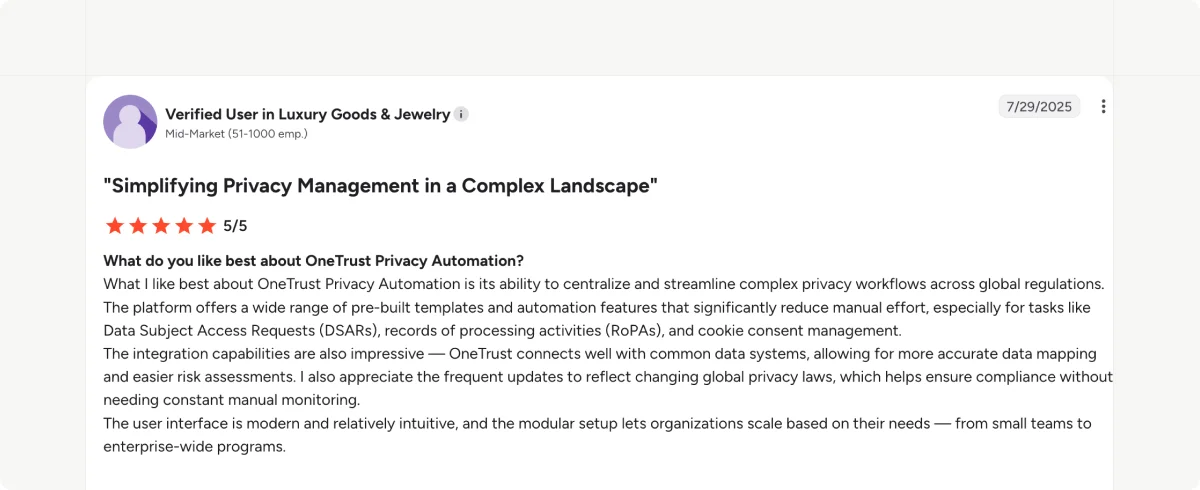
OneTrust is one of the most widely adopted enterprise privacy platform, serving organizations that want to manage privacy, compliance, governance, and risk from a single platform. Instead of focusing on one workflow, it brings together multiple products that organizations can adopt as their privacy programs mature.
Today, its portfolio spans six solution areas: Consent & Preferences, Privacy Automation, Tech Risk & Compliance, Third-Party Management, AI Governance, and Data Use Governance. Together, these cover everything from cookie consent and Data Subject Request (DSR) automation to privacy assessments, data mapping, vendor risk management, and AI governance.
OneTrust's biggest advantage is breadth. Teams can start with a single product, such as Consent Management, and expand into adjacent modules without introducing another vendor. That makes it particularly attractive for enterprises looking to consolidate privacy and governance under one platform.
Source: OneTrust G2 review
That breadth also makes OneTrust one of the more complex platforms to evaluate. Pricing is quote-based, with licensing depending on the products selected and metrics such as Average Daily Unique Visitors (ADUVs), privacy assets, vendor records, and administrator seats.
At the enterprise level, a Forrester Total Economic Impact study commissioned by OneTrust found that on average, an organization with $15 billion in revenue pays $292,000 annually for the platform, factoring in variables such as user count and usage limits. Read our blog to learn more about OneTrust Pricing.
OneTrust is best suited to enterprises that want privacy, risk, and governance under one contract and have the resources to support a larger implementation.
What is TrustArc?
.webp)
Source: TrustArc Website
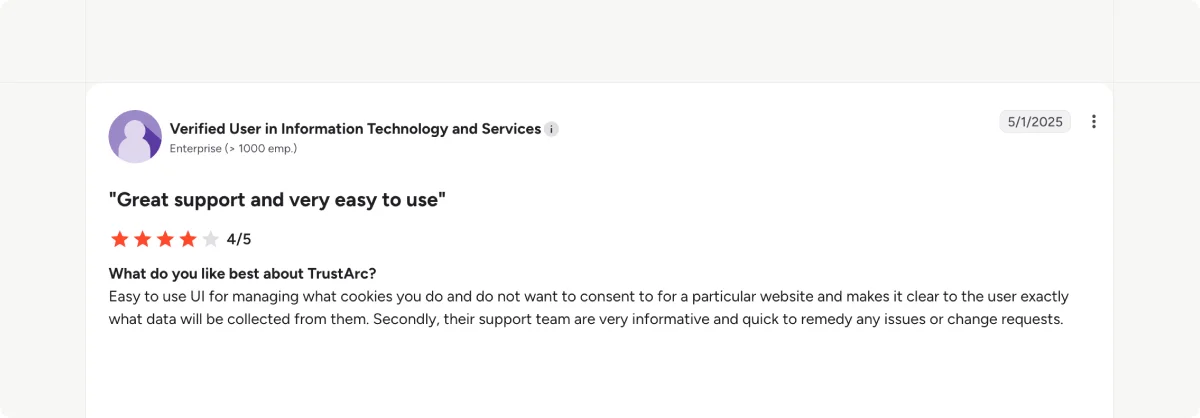
TrustArc is an established privacy technology company with a platform built specifically around privacy compliance rather than broader governance. While it overlaps with OneTrust across many core capabilities, its focus remains on helping privacy teams operationalize regulatory requirements with less platform complexity.
Its platform includes Consent Management, Data Subject Request (DSR) Automation, Data Mapping, Privacy Assessments, Vendor Risk Management, and Privacy Certification services. In addition to software, TrustArc is known for its regulatory intelligence, privacy certifications, and advisory expertise, which many organizations use alongside their operational privacy program.
Like OneTrust, TrustArc doesn't publish standard pricing. Vendors provide custom quotes based on deployment size, products licensed, and implementation requirements, making total cost difficult to estimate before entering a sales process.
TrustArc is best suited for organizations looking for mature privacy management capabilities without investing in a broader governance suite.
Source: TrustArc G2 review
Quick comparison: OneTrust vs TrustArc at a glance
Before diving into individual capabilities, here's a high-level TrustArc vs OneTrust comparison of how they differ across positioning, implementation, pricing, and overall customer experience.
OneTrust and TrustArc cover many of the same privacy workflows. The biggest differences lie in how those capabilities are delivered, the effort required to implement them, and the type of organization each platform is designed for. Let's take a closer look.
How OneTrust and TrustArc compare across core features
Feature checklists only tell part of the story. In practice, the buying decision often comes down to how each platform handles everyday privacy workflows, how much effort they take to operate, and how well they scale as your privacy program grows.
Here's how they compare across consent management, DSAR automation, data mapping, privacy assessments, AI governance, and more.
1. Consent & preference management
Both OneTrust and TrustArc provide enterprise-grade consent management, including customizable cookie banners, automated website scanning, geo-targeted consent experiences, consent preference centers, and support for regulations such as the General Data Protection Regulation (GDPR), California Consumer Privacy Act (CCPA)/California Privacy Rights Act (CPRA), and Lei Geral de Proteção de Dados (LGPD). Both also support Google Consent Mode v2 and the Interactive Advertising Bureau (IAB) Transparency and Consent Framework (TCF).
OneTrust positions consent management as part of its broader privacy and governance platform, making it easier for organizations already using other OneTrust modules to manage consent alongside assessments, data mapping, and compliance workflows. TrustArc focuses on delivering the same core capabilities through a more privacy-centric platform that's generally easier to implement and manage.
G2 reviewers rate OneTrust higher for Consent Management Platform (CMP) capabilities (8.5/10 vs 8.0/10), suggesting users see stronger functionality in OneTrust's consent offering, even though both platforms support the core enterprise requirements.
Verdict:
OneTrust is a better fit for organizations that want consent management tightly integrated with broader privacy and governance workflows.
TrustArc is a better fit for teams looking for a dedicated consent solution that's simpler to deploy and operate
2. Data Subject Access Request (DSAR) automation
Both OneTrust and TrustArc automate the end-to-end DSAR lifecycle, including request intake, identity verification, request tracking, fulfillment, and audit logging. Both support requests under regulations such as General Data Protection Regulation (GDPR) and California Consumer Privacy Act (CCPA), helping organizations meet statutory response timelines.
OneTrust manages DSARs as part of its broader Privacy Automation platform, allowing teams to connect requests with assessments, Records of Processing Activities (RoPAs), data mapping, and other governance workflows. TrustArc takes a privacy-first approach, offering configurable workflows and integrations that help organizations streamline request handling without requiring a broader governance platform.
G2 reviewers rate OneTrust higher for DSAR capabilities, with a score of 9.0/10 compared to 8.4/10 for TrustArc.
Verdict:
OneTrust is a better fit for organizations managing DSARs as part of a wider privacy governance program.
TrustArc is a better fit for teams looking for streamlined request management without the complexity of a larger governance suite.
3. Data mapping & discovery
Maintaining an accurate inventory of personal data is essential for compliance, risk management, and responding to privacy requests. Both platforms help organizations discover personal data, maintain RoPAs, and map how data flows across systems.
OneTrust offers automated data discovery alongside dynamic data mapping, making it easier to connect data inventories with assessments, vendor risk, and compliance reporting. TrustArc combines automated discovery with RoPA management and data inventories, helping teams maintain an up-to-date view of personal data across business systems.
On G2, OneTrust scores 8.7/10 for Data Privacy Management, compared to 7.8/10 for TrustArc.
Verdict:
OneTrust is a better fit for organizations looking for deeper data discovery and governance capabilities.
TrustArc is a better fit for covering the core requirements for maintaining privacy inventories while keeping the platform simpler to manage.
4. Privacy assessments
Privacy assessments help organizations evaluate risks before launching new products, vendors, or data processing activities. Both platforms support Privacy Impact Assessments (PIAs), Data Protection Impact Assessments (DPIAs), configurable questionnaires, automated workflows, and approval processes.
OneTrust offers highly customizable assessment templates that integrate with its broader privacy and governance ecosystem, enabling organizations to link assessments with data maps, vendor records, and compliance reporting. TrustArc includes pre-built assessment templates aligned with common privacy regulations, configurable workflows, and approval processes that help organizations standardize Privacy Impact Assessments (PIAs) and Data Protection Impact Assessments (DPIAs).
G2 users rate OneTrust 8.8/10 for Privacy Impact Assessment (PIA) capabilities, compared to 8.2/10 for TrustArc.
Verdict:
OneTrust is a better fit for organizations managing large volumes of assessments across multiple teams.
TrustArc is a better fit for privacy teams that want structured assessments without extensive configuration.
5. Integrations & ecosystem
A privacy platform is only as effective as the systems it connects to. Both OneTrust and TrustArc integrate with common enterprise applications, cloud platforms, identity providers, ticketing tools, and business systems to automate privacy workflows and reduce manual effort.
OneTrust has the broader integration ecosystem, with hundreds of pre-built integrations across CRM, HR, cloud, security, collaboration, and developer tools. It also offers APIs and integration capabilities that make it easier for large enterprises to connect privacy workflows across complex technology stacks.
TrustArc integrates with platforms including ServiceNow, Salesforce, Microsoft 365, Okta, Jira, and other enterprise applications through pre-built integrations and APIs, helping automate privacy workflows across existing business systems. While its ecosystem is smaller than OneTrust's, it covers the integrations most organizations rely on for privacy operations.
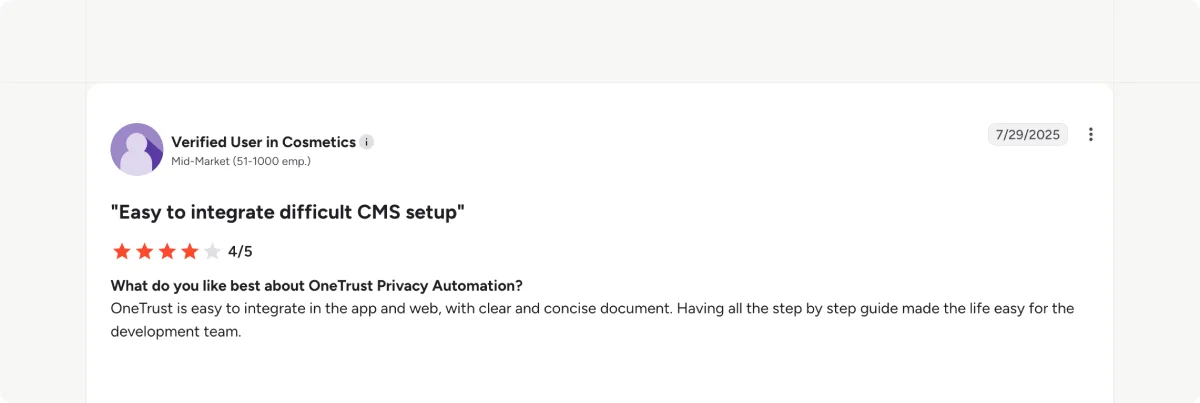
Source: TrustArc G2 review
While G2 doesn't provide a dedicated integrations score, OneTrust scores slightly higher for Meets Requirements (8.8/10 vs 8.7/10), reflecting its ability to support a wider range of enterprise use cases.
Verdict:
OneTrust is a better fit for organizations looking to integrate privacy operations into a larger enterprise technology ecosystem.
TrustArc is a better fit for teams that need integrations with their core business systems without the complexity of a broader governance platform.
6. Reporting & audit readiness
Demonstrating compliance is just as important as achieving it. Both OneTrust and TrustArc provide audit trails, reporting dashboards, consent records, assessment histories, and documentation that help organizations prepare for internal reviews and regulatory audits.
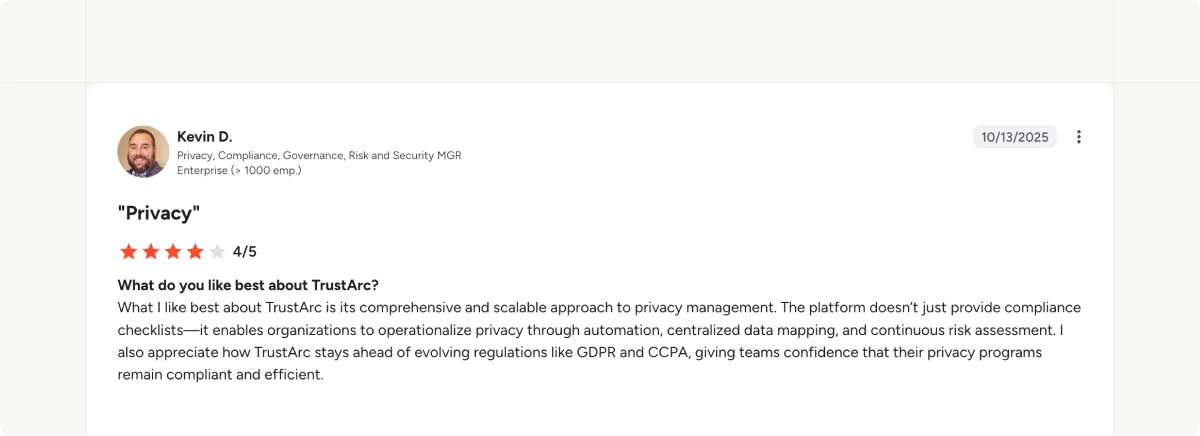
Source: OneTrust G2 reviews
OneTrust offers highly customizable dashboards and reporting across its privacy, governance, and risk modules, making it easier to consolidate compliance evidence from multiple workflows. TrustArc provides configurable dashboards, audit trails, assessment histories, consent records, and evidence reporting designed to help organizations demonstrate compliance during internal reviews and regulatory audits.
G2 reviewers rate both platforms similarly for overall usability, with OneTrust scoring 8.4/10 for Ease of Admin and TrustArc scoring 8.3/10, suggesting comparable day-to-day management experiences despite their different approaches.
Verdict:
OneTrust is a better fit for organizations that need consolidated reporting across privacy, governance, and risk programs.
TrustArc is a better fit for providing the reporting and audit capabilities most privacy teams need while keeping the experience focused on core compliance workflows.
7. AI governance
As organizations adopt generative AI, many privacy teams are also evaluating tools that can inventory AI systems, assess AI-related risks, and support emerging regulations such as the European Union Artificial Intelligence Act (EU AI Act).
OneTrust includes dedicated AI governance capabilities alongside its privacy platform, allowing organizations to manage AI inventories, conduct AI risk assessments, and align governance workflows with broader compliance programs. TrustArc remains focused on core privacy operations, offering strong privacy management capabilities but not the same breadth of AI governance functionality.
Verdict:
OneTrust is a better fit for organizations that want to manage AI governance alongside privacy and compliance within a single platform.
TrustArc is a better fit for teams whose primary focus remains traditional privacy compliance rather than enterprise AI governance.
Cost comparison of OneTrust vs TrustArc
Neither OneTrust nor TrustArc publishes pricing on their website. Both use custom quotes based on the modules purchased, deployment scope, contract length, and implementation requirements. That makes it difficult to estimate total cost without engaging with sales, but procurement benchmarks from Vendr provide a useful indication of what buyers typically pay and where costs tend to increase.
Sources: Vendr Marketplace procurement benchmarks and enterprise pricing research for OneTrust and TrustArc (July 2026).
Both platforms rely on negotiated enterprise pricing, so the final cost depends heavily on the modules purchased, implementation scope, and contract length. Based on available procurement data, OneTrust is generally the more expensive platform, particularly for organizations adopting multiple governance modules, while TrustArc tends to offer a lower total cost of ownership for teams focused primarily on privacy compliance.
Where OneTrust wins
OneTrust is the stronger choice if your privacy program extends beyond compliance into broader governance and risk management. It's best suited for organizations that want to standardize multiple privacy workflows within a single enterprise platform.
- You need AI governance, Governance, Risk, and Compliance (GRC), and privacy operations in a single platform. OneTrust combines consent management, assessments, data mapping, third-party risk, AI governance, and compliance workflows, making it a better fit for organizations looking to consolidate governance tools.
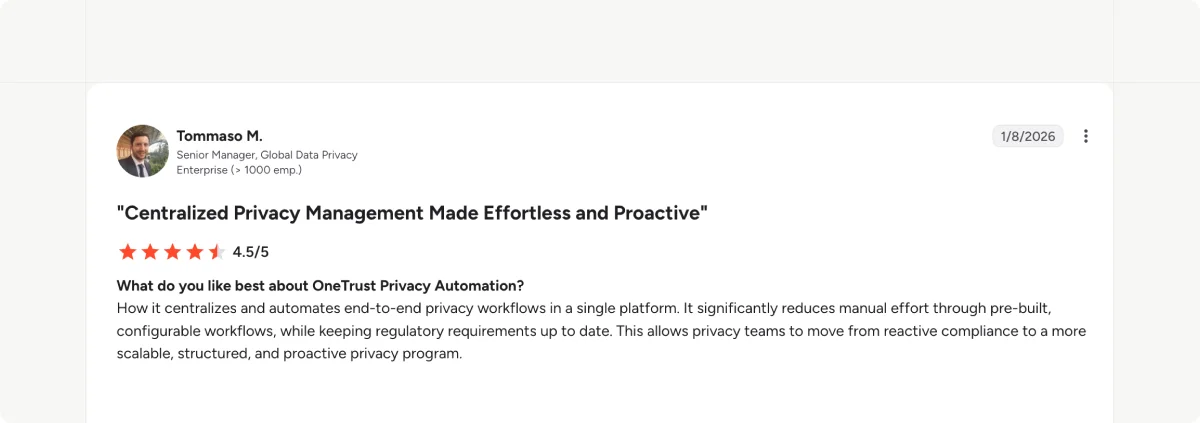
Source: G2
- You operate across multiple jurisdictions. Its extensive regulatory coverage, configurable workflows, and enterprise-scale governance capabilities make it well suited for organizations that manage compliance across multiple regions.
- Your privacy team prefers configurable workflows over engineering-heavy implementations. OneTrust's dashboard-driven approach allows teams to manage consent, assessments, and compliance without relying heavily on developers for everyday operations.
| Related Read - 13 Best OneTrust Competitors and Alternatives in 2026
Where TrustArc wins
TrustArc is a strong alternative for organizations that want mature privacy management capabilities without the added complexity of a broader governance platform. It focuses on the core workflows most privacy teams manage every day.
- You're replacing OneTrust and want the closest feature-equivalent alternative. For teams actively comparing TrustArc vs OneTrust during a renewal cycle, this is often the deciding factor. TrustArc covers consent management, DSAR automation, data mapping, privacy assessments, and vendor privacy management, making migration easier than moving to developer-first platforms.
- Your priority is privacy compliance, not enterprise governance. If AI governance, GRC, and broader risk management aren't part of your requirements, TrustArc delivers the core privacy capabilities most teams need with less platform overhead.
- You want faster time to value. TrustArc is generally quicker to implement than OneTrust, with a G2 Ease of Setup score of 8.1 against OneTrust's 7.8.
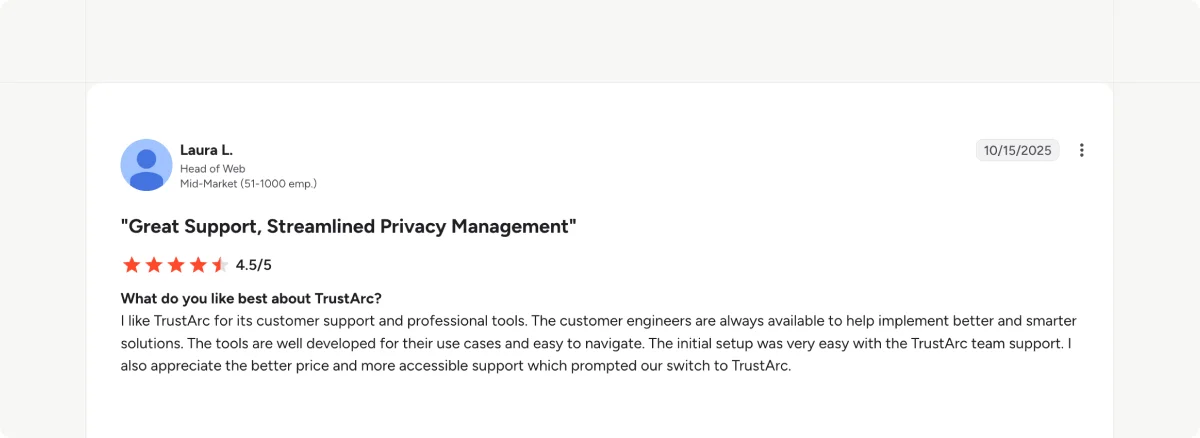
Source: G2
By this point, the choice between TrustArc vs OneTrust should be clearer. OneTrust is the better fit for organizations looking for a broader governance platform, while TrustArc is better suited to teams focused on core privacy operations with a simpler implementation.
That said, choosing between the two doesn't solve every privacy challenge. Both platforms are designed to help organizations manage consent, privacy requests, assessments, and data mapping. Neither was built to continuously verify whether those privacy controls are actually working across live websites and mobile apps after implementation.
Who should consider a third option
Neither OneTrust nor TrustArc continuously verifies whether your websites and mobile apps remain compliant after consent has been collected. They record a user's consent choice, but they don't continuously verify that every marketing pixel, analytics tag, SDK, or third-party vendor actually respects that choice in production.
Organizations can no longer ignore that gap. Privado AI's analysis of the top 250 websites by traffic across California, France, and the UK found that 90% failed at least one GDPR or CCPA compliance test, despite many already running an enterprise consent management platform, despite many already using enterprise consent management platforms. The underlying issue is verifying that consent is consistently enforced across live digital properties.
This is particularly relevant for organizations that:
- Need continuous monitoring for GDPR, CCPA, Global Privacy Control (GPC), and IAB TCF compliance across different geographies.
- Face growing litigation risk under regulations such as the California Invasion of Privacy Act (CIPA) and the Video Privacy Protection Act (VPPA) and need network-level evidence that non-consenting users' data wasn't shared.
- Regularly add new marketing pixels, analytics tools, or third-party SDKs without revalidating existing consent configurations.
- Need visibility into undisclosed SDKs embedded within mobile applications.
- Rely on manual questionnaires for privacy assessments and static data maps that quickly become outdated as systems change.
These operational challenges exist regardless of whether your organization uses OneTrust, TrustArc, or another enterprise privacy platform. Whether you're weighing TrustArc vs OneTrust for a new purchase or already running one of the two, the verification gap looks the same. They're a different category of problem that requires continuous verification rather than workflow management.
What Privado AI does that OneTrust and TrustArc don't
Privado AI complements platforms like OneTrust and TrustArc by continuously verifying that privacy controls are working as intended across production websites and mobile applications. Instead of replacing your privacy platform, it provides an independent verification layer that identifies compliance issues before regulators, customers, or legal teams do.
Its capabilities include:
- Web Auditor continuously scans websites across different geographies, simulates user consent choices, verifies that third-party technologies respect those choices, and identifies violations down to the exact request and line of code.
.webp)
- App Auditor performs the same verification for iOS and Android applications, identifying undisclosed SDKs, unauthorized data collection, and consent enforcement issues that aren't visible through manual reviews.
.webp)
- Wren, Privado AI's AI privacy analyst, automates privacy assessments from intake through remediation. Instead of sending questionnaires between legal, engineering, and business teams, Wren identifies new processing activities, generates assessments, and tracks outstanding risks automatically.
.webp)
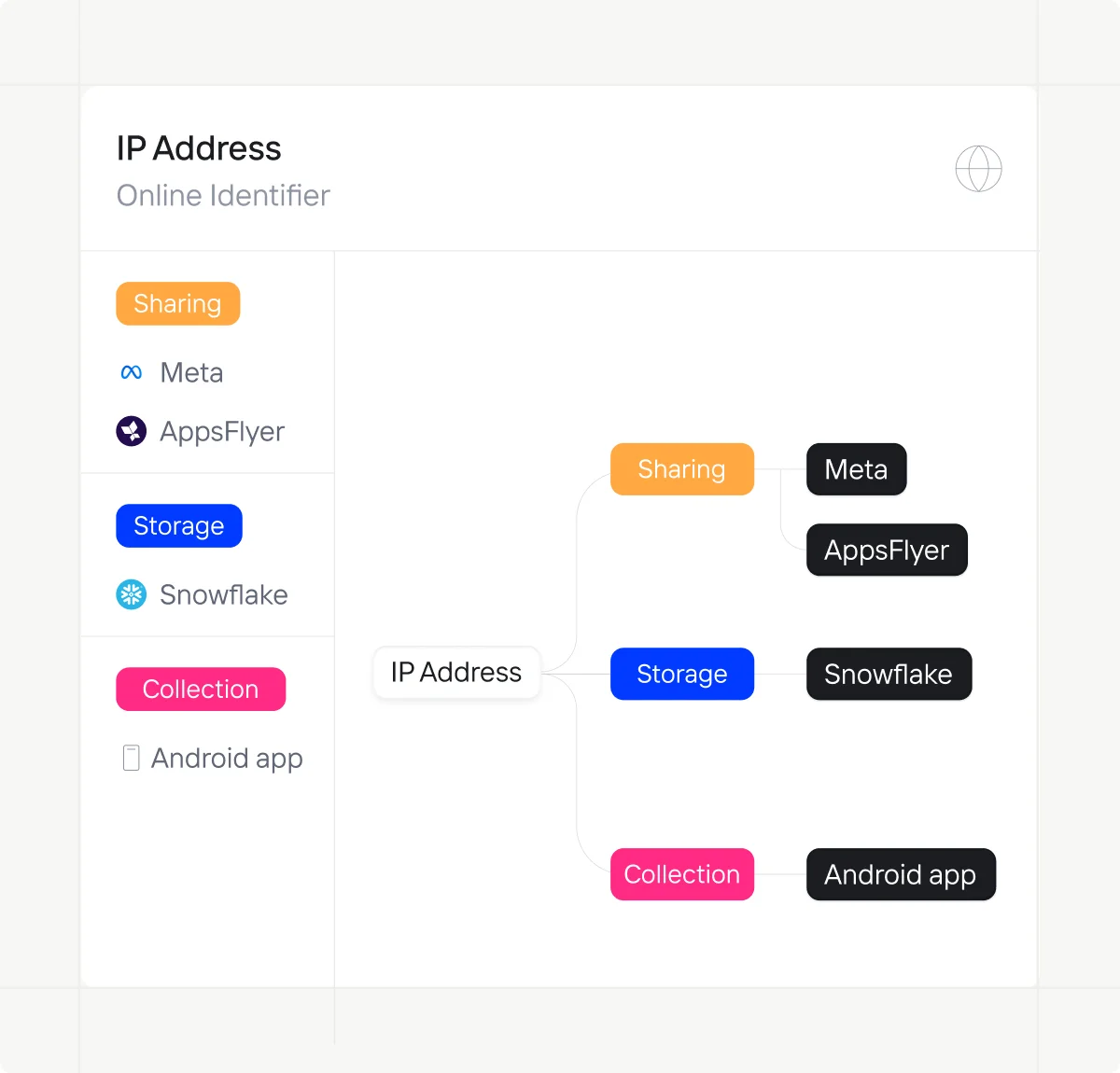
- Dynamic Data Maps automatically discover and update data flows as applications evolve, replacing static data inventories with continuously refreshed records.
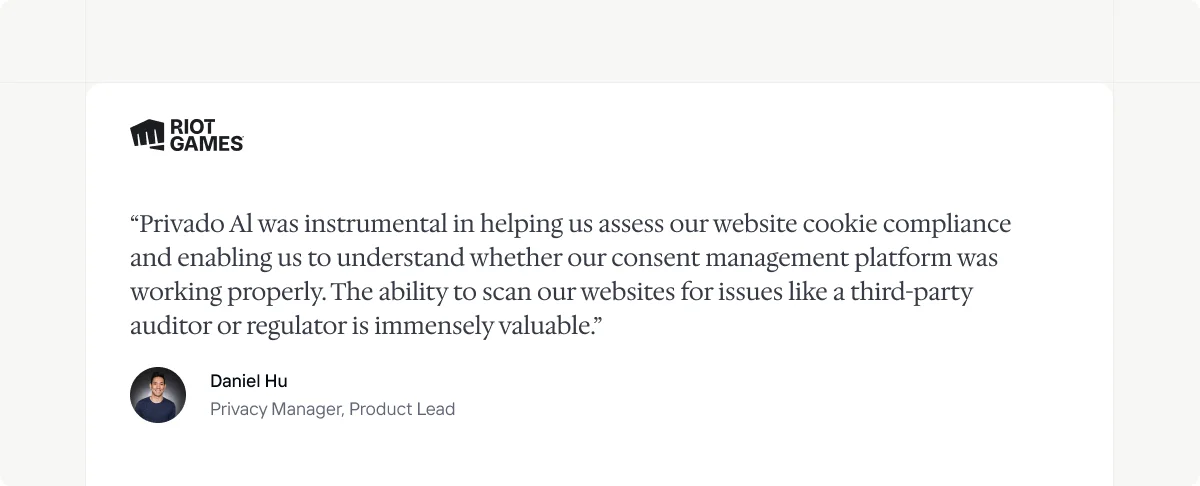
Organizations such as ZoomInfo, Riot Games, and Headspace use these capabilities to identify issues that traditional workflow platforms cannot detect. Customer reviews on G2 and Capterra also highlight faster audits, improved visibility into data flows, and reduced manual effort for privacy teams.
If your organization already uses OneTrust or TrustArc, Privado AI is an additional layer of continuous compliance verification that helps ensure the controls you've implemented are actually working in production.
Book a demo to see how Privado AI works alongside OneTrust and TrustArc to continuously verify compliance across your websites and mobile apps.
Legal disclaimer:
This article is for informational purposes only and does not constitute legal or procurement advice. Pricing figures are third-party procurement reports and estimates, not published vendor rates. G2 scores are accurate as of [date]. Verify current terms and pricing directly with each vendor.
FAQs
Is TrustArc better than OneTrust?
Whether TrustArc is better than OneTrust depends on your organization's priorities. OneTrust offers a broader platform with AI governance, GRC, and enterprise-scale privacy operations, while TrustArc focuses on core privacy management with a simpler implementation and user experience. Organizations focused primarily on privacy compliance may find TrustArc to be the better fit.
Is OneTrust worth the higher cost?
OneTrust is worth the higher cost if you need a single platform for privacy operations, AI governance, third-party risk, and compliance. If your primary requirement is consent management, DSAR automation, and privacy assessments, TrustArc may deliver similar core functionality with a lower total cost of ownership.
Can TrustArc handle enterprise-level compliance?
Yes, TrustArc can handle enterprise-level compliance. It supports consent management, DSAR automation, data mapping, privacy assessments, vendor privacy management, and compliance with regulations including GDPR, CCPA, and LGPD. However, organizations needing broader governance capabilities, such as AI governance or GRC, may find OneTrust covers more of that ground.
Is TrustArc a good alternative for teams leaving OneTrust?
Yes, TrustArc is one of the closest alternatives to OneTrust for organizations focused on privacy operations. It offers comparable capabilities for consent management, DSARs, privacy assessments, and data mapping, while generally providing a simpler user experience and faster implementation than OneTrust.
Industry insights you won’t delete. Delivered to your inbox.
Get regular updates from Privado AI
Request free website audit
Request Privado AI demo
Share
Author
.webp)