
How much US wiretapping settlements and increasing and why?
Thank you!
Please check your email to view the guide.
Cookie consent audit: What a real audit reveals
September 8, 2026
5
mins read
Author




A consent banner can appear to work while the website behind it tells a different story. A user may reject tracking or send a Global Privacy Control (GPC) signal, yet advertising pixels can still fire if a tag, script, or Consent Management Platform (CMP) setting is incorrect.
That gap was the focus of an August 19, 2026 webinar from Myna Partners and Privado AI. Dave Cohen and Jimmy Durante of Myna Partners joined Vaibhav Antil, CEO and co-founder of Privado AI, to walk through what a real cookie consent audit checks and where programs tend to fail. The session covers cookie scanning, CMP configuration, GPC recognition, pre-consent tag firing, and privacy notice validation.
The discussion is not limited to whether a banner exists. It looks at whether the website follows the user's choice, what regulators are checking in 2026, and how privacy teams can keep consent controls working as marketing technology changes.

Meet the speakers
Director, Myna Partners
Dave Cohen has worked in information privacy for more than 13 years, with experience across privacy compliance and operational controls. He holds Certified Information Privacy Professional credentials for the United States and Europe, or CIPP/US and CIPP/E. Before joining Myna Partners, he worked at the International Association of Privacy Professionals.
Senior Solutions Engineer, Myna Partners
Jimmy Durante works on the technical side of privacy programs, including consent management implementation and website auditing. During the webinar, he walked through the audit methodology Myna Partners uses to examine CMP configuration, cookie categorization, GPC handling, and tracker behavior. His current role is confirmed on the Privado AI webinar page.
CEO and Co-Founder, Privado AI
Vaibhav Antil brings the product and privacy engineering perspective to the discussion. His work at Privado AI focuses on giving privacy teams technical evidence of how websites, mobile apps, and internally developed software process personal data.
Why cookie consent is still a compliance risk in 2026?
Cookie consent risk increasingly sits in the gap between what a company tells users and what its website does after a choice is made. A banner can correctly record an opt-out, while a tag manager, first-party script, embedded vendor, or server-side workflow continues sending data.
This is why the audit needs to test behavior rather than stop at the interface. Recent California enforcement has examined whether opt-outs work in practice, whether tracking continues after a request, and whether privacy disclosures match the underlying data use.
Dave Cohen described the standard during the webinar in simple terms: “Say what you do, and then do what you say.”
Several changes make that harder than it sounds.
- Tracking extends beyond cookies. Websites now use pixels, scripts, beacons, server-side integrations, and other tracking technologies. Vaibhav also discussed conversion APIs and domain cloaking, which can make third-party data sharing harder to spot through a basic cookie inventory.
- Vendor relationships create hidden data flows. A technology approved by one team may load another vendor or additional script. Those relationships become difficult to govern when there is no clear business owner or contract for the downstream technology.
- Consent controls change with the website. A CMP may work correctly when configured, then fall out of sync after a campaign launch or tag update. Privado AI’s CCPA compliance playbook for 2026 explains why privacy teams need evidence that an opt-out reached the systems that matter.
Dave also distinguished between internal privacy commitments and the notice presented to users. Organizations use “privacy policy” and “privacy notice” differently, so the practical point matters more than the terminology. Public disclosures should reflect the tracking technologies and data flows currently operating on the website.
What a cookie consent audit actually checks?
A cookie consent audit tests the full path from the privacy choice shown to a user through the technologies that respond to that choice. Jimmy Durante walked through seven parts of the Myna Partners audit process during the webinar.
Website scanning and cookie inventory
The audit begins by crawling the website and creating an inventory of cookies and related storage technologies. A useful scan also captures network activity so the team can see which external destinations receive requests.
The result should not be restricted to “How many cookies are there?” Privacy teams need to understand who placed each cookie, what category it belongs to, and whether it appears under the correct consent state.
Tag and tracker discovery
The next step identifies pixels, scripts, tags, and other third-party technologies operating across the website.
Jimmy used advertising pixels as an example. Meta, LinkedIn, and TikTok technologies would normally require treatment consistent with their advertising purpose. An audit can uncover situations where the technology sits in a performance or functional category instead.
Cookie classification still requires judgment. Some cases are clear, while others depend on purpose and implementation. Legal counsel should make decisions where categorization affects the legal position.
CMP configuration review
A CMP audit asks whether the banner does what its interface says.
If a user selects “Accept All,” does the resulting consent state reflect that choice? When the visitor rejects tracking, do the relevant technologies stop? The same test should be repeated from locations where different legal rules apply.
In an opt-in jurisdiction, non-essential technologies should not begin processing before the required choice has been obtained. The banner appearing on screen does not prove this behavior.
GPC signal testing
GPC testing checks whether the website detects a Global Privacy Control signal and applies the required opt-out.
This deserves separate attention because both Vaibhav and Jimmy described GPC handling as a frequent source of audit findings. A website can recognize the signal in its interface, while the underlying technologies continue to behave as though no opt-out exists.
Pre-consent tag firing analysis
Pre-consent tag firing is tested by loading a website before interacting with its banner and watching which technologies activate.
If advertising or other non-essential technologies fire before the required consent is obtained, the visible banner has not prevented the underlying activity.
Jimmy described one common implementation failure during the webinar. Teams install a CMP and assume the implementation is complete without configuring the tag controls needed behind it.
This problem can also appear with Google infrastructure. Privado AI’s research into Google Consent Mode compliance risk found that websites can send incorrect downstream signals even when the consent layer appears to be working.
Privacy notice validation
The audit should also check whether users can find the relevant privacy information and whether disclosures reflect the technologies being used.
A website may have a privacy notice that has not been updated since new vendors were introduced. The cookie list can also fall behind the live implementation.
The objective is alignment. If the website uses advertising technology or sends personal data to a third party, the public-facing disclosures should be reviewed against these practices.
Documentation and governance review
The final stage turns technical findings into work the organization can manage.
Myna Partners described reports that combine findings with a compliance score and remediation actions. A website might pass some checks while failing GPC handling or tag blocking. The score gives the team a starting point, while the evidence shows what needs attention.
A thorough audit also identifies the owner responsible for each issue and establishes a path for retesting after remediation.
Why does GPC testing uncover so many issues?
Global Privacy Control (GPC) changes the timing of an opt-out. The user does not need to reach the banner and click a button first. A supported browser sends the preference when the website loads.
For businesses subject to the California Consumer Privacy Act (CCPA) opt-out requirement, qualifying GPC signals must be treated as valid requests to stop covered sale or sharing. California’s rules effective January 1, 2026 also require businesses to display whether the signal was processed as an opt-out.
Vaibhav described the effect during the webinar as similar to arriving on the website with the opt-out already selected.
The audit can still uncover several failure modes.
Signal recognized without enforcement
A CMP can detect GPC and display that recognition while advertising activity continues.
Recognition and enforcement are different technical events. Privacy teams need to inspect cookies and network requests after the signal reaches the website.
Incomplete category coverage
A GPC rule may block one category while leaving other covered technologies active.
Jimmy discussed examples where teams configured the signal against targeting cookies without reviewing other non-essential categories. The correct treatment depends on the applicable requirement and the processing involved.
Race conditions
Timing can also break an implementation.
A pixel may load before the CMP has finished reading and applying the GPC signal. By the time the banner reflects the opt-out, the first network request may have already left the website.
This is why testing should cover more than the homepage. Different templates and embedded components can load technologies in a different order.
Missing confirmation
California’s 2026 regulations add another operational check. A business must provide a way to show whether an opt-out preference signal was processed as a valid opt-out request.
The audit therefore needs to check two questions: Did the website honor the signal, and can the user tell that it did?
What else does a cookie compliance audit find?
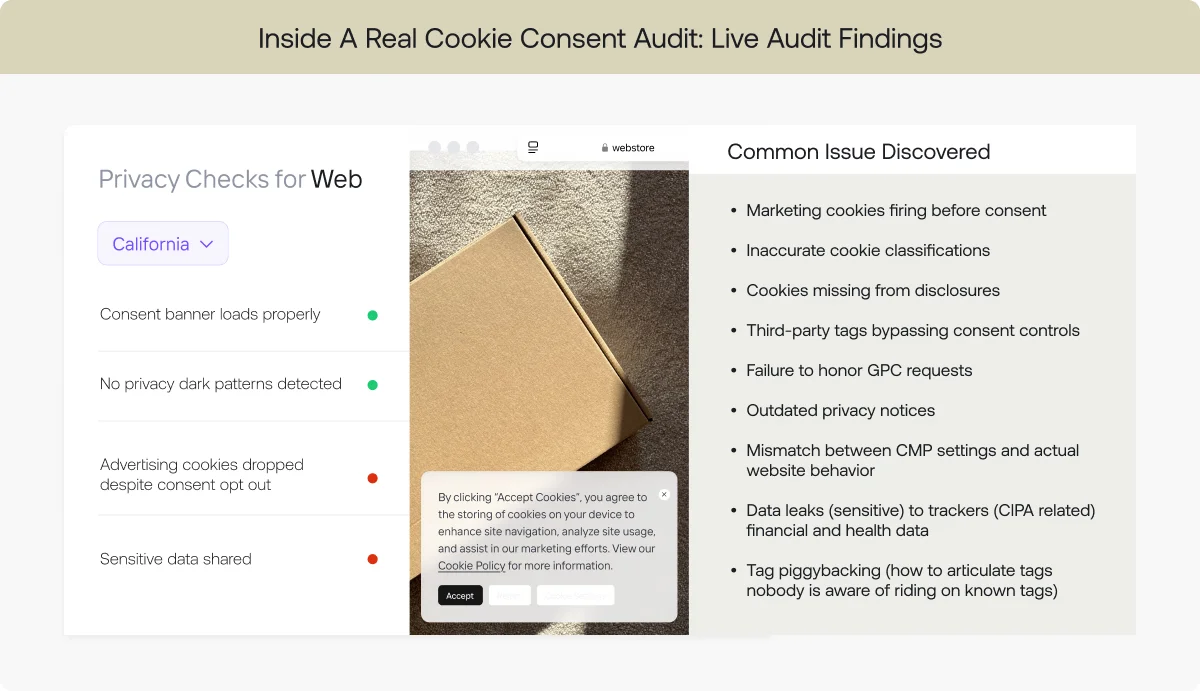
GPC is one failure mode. A broader cookie compliance audit can expose other gaps that are easy to miss when teams only review CMP settings.
- Tags firing before consent: Advertising scripts or analytics tools may load before the CMP applies the required consent state.
- Consent signals not reaching Google: A CMP can send a consent value, but Google Tag Manager or another downstream system may be configured incorrectly and not apply it.
- Embedded media loading trackers: YouTube videos, social widgets, or other embedded services can create network requests when the page loads. Privacy-preserving deployment options may exist, but teams need to configure them.
- Sensitive information reaching pixels: Form values or user attributes can appear in advertising payloads. The risk increases when the information involves health, financial, location, or other sensitive contexts.
- Tag piggybacking: A vendor approved by the company can introduce other third parties via its own technology. Privado AI’s digital tracking governance guide explains why teams need visibility beyond the first vendor in the chain.
- Incorrect cookie categories: A cookie can be classified differently from its actual purpose, leading to the wrong consent rule being applied.
Why audit cadence matters
A clean audit is a snapshot, not a permanent state.
During the webinar, Vaibhav shared an example of a customer that discovered an issue through a scan and delayed remediation. According to his account, the company received a CCPA-related claim concerning the same issue within weeks.
That example should not be read as a general litigation statistic. It does show why privacy teams cannot assume that regulatory timelines define how quickly a website may be tested by another party.
The safer operating model is to scan again after material website changes rather than waiting for an annual privacy review.
What do 2026 CCPA enforcement actions show?
Recent California enforcement actions reinforce the same point raised throughout the webinar: a privacy control needs to work across the systems affected by the consumer’s choice.
The table has been updated against the official California enforcement records.
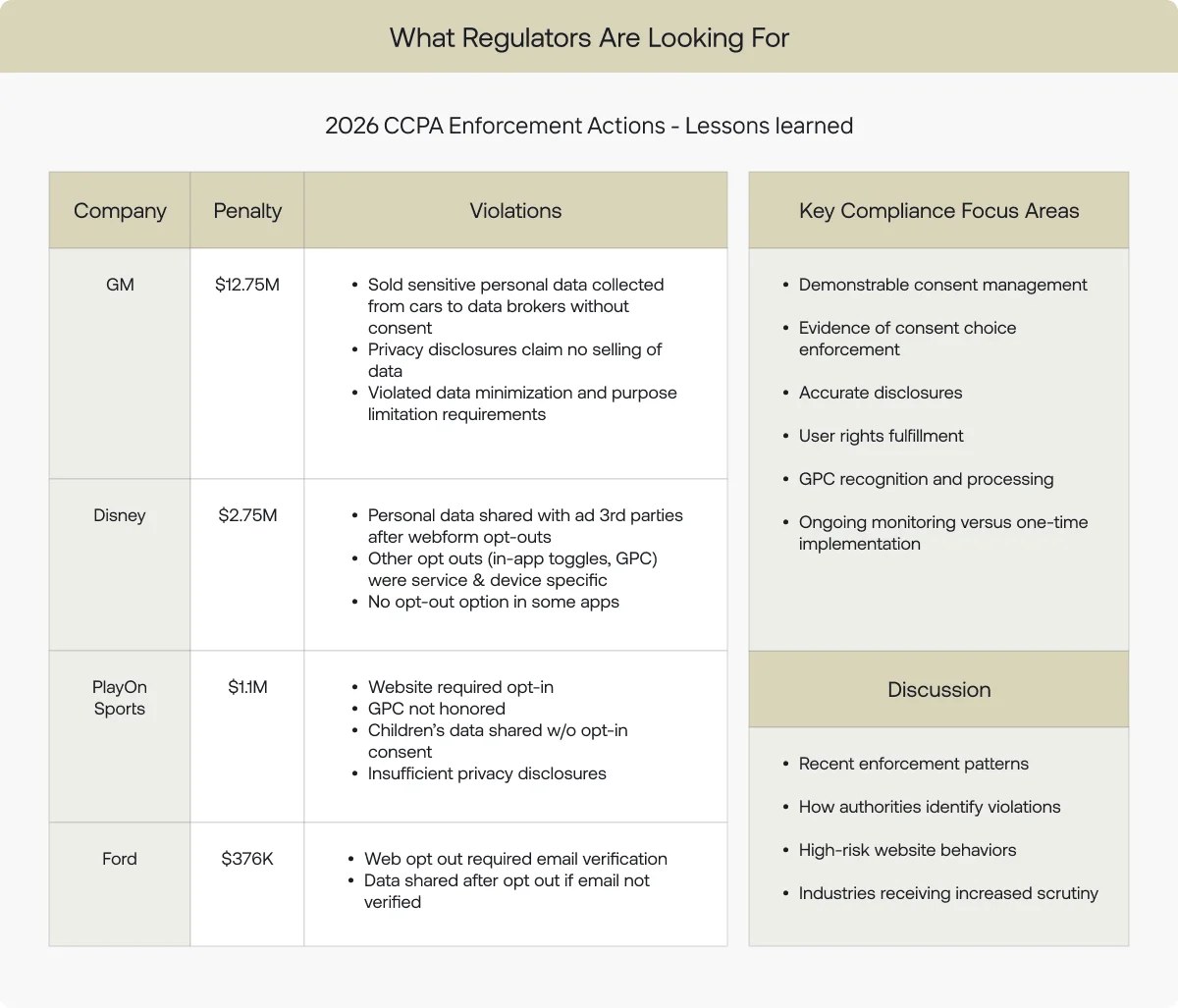
The cases also show different types of failure.
GM involved data minimization and a mismatch between disclosed practices and data use. Privado AI’s analysis of the GM settlement explains why the case matters beyond connected vehicles.
Disney shows what happens when an opt-out works in one place but doesn't propagate across the account. Privado AI’s Disney CCPA settlement analysis examines the device and service gaps highlighted by the Attorney General.
PlayOn Sports involved an “agree” flow without an adequate way to opt out of tracking. The company also failed to recognize opt-out preference signals. Privado AI covers the enforcement details in its PlayOn Sports CCPA analysis.
Ford illustrates a different problem. The opt-out process added an email verification step that California said created unlawful friction. Privado AI’s Ford CCPA enforcement analysis looks at why an extra step became a compliance issue.
The lesson is broader than any one mechanism. Consent programs need testable controls, evidence of whether they worked, and a process for fixing failures as websites change.
Does a cookie consent audit cover mobile apps?
The legal question may be similar, but the technology being tested changes.
On a website, auditors can inspect cookies, scripts, network activity, and banner behavior with browser tools. Mobile applications rely more heavily on SDKs and device-level requests, which require a different testing approach.
Vaibhav made this distinction during the webinar. The fact that privacy teams cannot open browser developer tools on an app does not mean app behavior is invisible to regulators or plaintiffs.
An app audit should therefore identify active SDKs and examine which third parties receive data. It should also test user journeys under the consent choices available in the app.
Device-level privacy settings are another part of the picture. They can control activity mediated by the operating system, but they should not be treated as proof that every third-party SDK has stopped transmitting data.
Privado AI App Auditor can begin from an app store URL or supported application file. The product simulates user behavior and records data-flow activity without requiring Privado AI code to be added for the initial audit.
What does a strong cookie consent program look like?
The webinar closed with a practical set of actions that privacy teams can apply after the first audit.
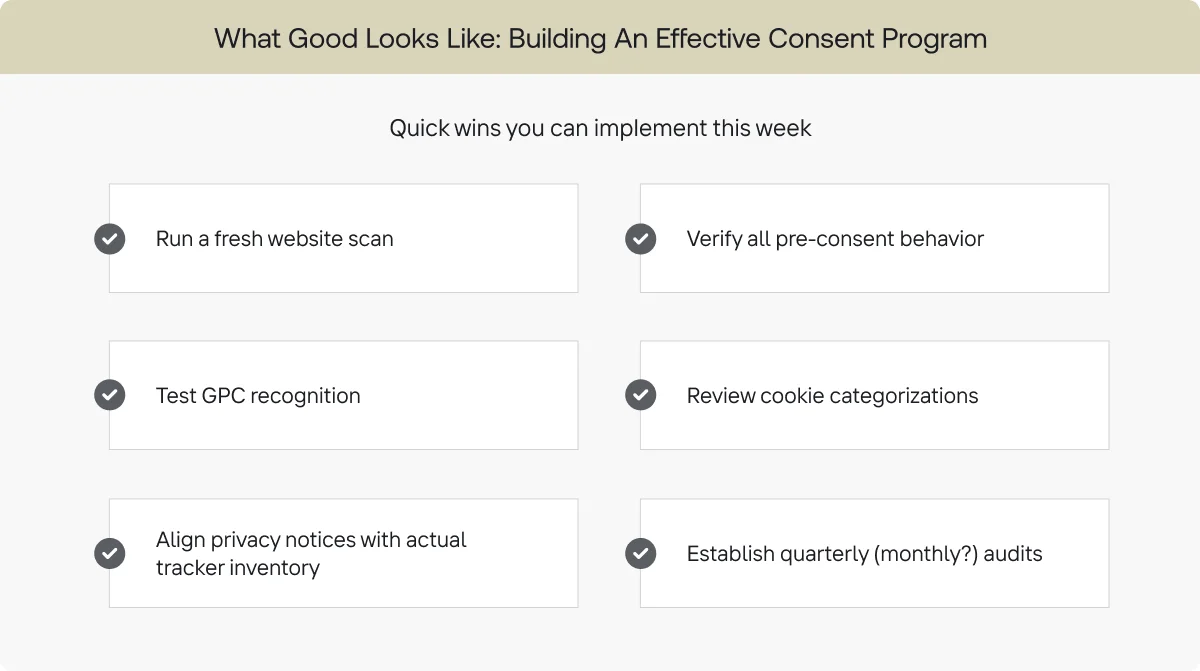
- Run a current website scan: Establish what the website does today rather than relying on an older inventory.
- Test behavior before consent: Check whether non-essential technologies load before the required choice is made.
- Prioritize GPC testing: Verify recognition, downstream enforcement, and the required user-facing status.
- Review cookie categories: Revisit ambiguous classifications with legal counsel when the category affects compliance.
- Match notices to live tracking: Update disclosures when vendors or data flows change.
- Set a repeat audit schedule: Use monthly or quarterly reviews based on risk, then add checks around major releases.
For a broader checklist, Privado AI’s Web Privacy Governance Guide for the US brings together the main website privacy risks and controls privacy teams should review.
Put a gate on new tracking technologies
The strongest program does not wait for the next scheduled audit to find a problem.
Jimmy described change management as a common gap. A website can pass today and fail after a new campaign introduces another tag.
A mature workflow gives new tracking technology an owner and an approval path. New websites can be scanned before launch. Material changes can be tested in a QA or staging environment before they reach production.
This changes the role of the audit. Instead of repeatedly discovering the same class of failure, the organization begins preventing known problems from reaching users.
Build a working relationship with marketing
Marketing teams will keep testing new platforms and campaign technology. Trying to stop that work is not a realistic privacy operating model.
Dave’s recommendation was to create a standing channel between privacy and marketing. Privacy needs to know about a new pixel before it is deployed, while marketing needs a review process that does not stall every campaign.
The same relationship should extend to web and engineering owners when they control tag managers or release processes.
How Privado AI supports a cookie consent audit
Privado AI Web Auditor provides the technical evidence that privacy teams need to test website behavior beyond the CMP dashboard. It can scan a website at selected locations without adding Privado AI code to it.
The role is different from a CMP. A CMP captures and manages user choices. Web Auditor independently checks whether cookies, pixels, scripts, and downstream data flows follow those choices.
Consent actions become test journeys
Web Auditor simulates website journeys under relevant consent states rather than relying on one crawl.
That can include accepting or rejecting the banner and testing GPC in locations where it applies. Privado AI then records the cookie and network activity produced by those choices.
The result gives the privacy team evidence of what happened after the user decision.
Website activity is checked against privacy controls
Web Auditor discovers third-party cookies, pixels, and scripts, then maps which consent actions trigger them. It also builds data-flow maps showing information sent to third parties.
Privado AI currently provides more than 50 preset checks covering CCPA, CIPA, the General Data Protection Regulation, and other requirements. Checks also cover banner and compliance-link visibility.
Cookie categorization gets a separate evidence layer
Misclassification can undermine an otherwise well-configured consent program.
Privado AI’s Cookie Agent verifies cookie categories using cookie databases and vendor information, then Web Auditor uses that categorization when evaluating consent behavior. This helps teams identify a targeting cookie that has been classified as functional or analytics, for example.
Findings connect to remediation
The value of a scan depends on whether the team can act on the result.
Web Auditor creates evidence around the banner, cookie, pixel, or data flow involved. Privado AI can also generate developer tickets with remediation guidance through supported workflows such as Jira and Linear.
Scans can then be repeated after the fix or scheduled as the website changes.
This is where Privado AI fits into the wider audit program. Myna Partners brings privacy program assessment and remediation expertise. Privado AI provides repeatable technical evidence from the live website. The software supports the program rather than replacing legal review or program ownership.

What should privacy teams do next?
A cookie compliance audit should start with the controls that expose failures fastest. Test GPC and check what fires before consent. Then compare the live-tracker inventory with the privacy notice and review whether the tags are classified correctly.
The next step is governance. Put an approval gate around new tracking technology and retest after material changes to the website. A quarterly audit may suit some programs, while higher-risk websites may need a shorter cycle.
A consent banner tells users what should happen. A cookie consent audit provides the evidence showing whether the website follows through.
Watch the full Myna Partners and Privado AI webinar for the audit walkthrough, or run a Privado AI Web Auditor scan to review consent enforcement on your own website.
Run a free Privado AI website audit to see which cookies, pixels, and data flows still operate after users opt out.
Disclaimer: This article is for informational purposes only and does not constitute legal advice. Cookie categorization, consent requirements, and enforcement expectations vary by jurisdiction and by the facts of a given implementation. Consult qualified counsel for guidance specific to your organization.
FAQs
What is a cookie consent audit?
A cookie consent audit tests whether a website behaves in line with the consent choices it presents. The audit can review cookies and trackers, CMP configuration, GPC handling, pre-consent behavior, privacy disclosures, and governance controls. The goal is to identify where the visible consent experience differs from the website’s underlying technical behavior.
How often should a business run a cookie compliance audit?
The right audit frequency depends on how often the website changes and the level of privacy risk. The webinar recommends quarterly audits as a baseline, with monthly or release-based testing for higher-risk environments. Mature programs also scan new websites and material changes before those updates reach production.
Why do cookies fire before consent when a CMP is installed?
Cookies can fire before consent when the CMP is installed without the tag-blocking configuration needed behind it. Scripts may also load before the CMP processes the user’s choice. Another failure can occur when consent signals reach a tag manager, but the downstream technology has not been configured to apply them.
Do businesses have to honor Global Privacy Control signals?
Covered businesses subject to California’s CCPA sale or sharing opt-out requirements must process qualifying GPC signals as valid opt-out requests. California’s regulations, effective January 1, 2026, also require businesses to indicate whether the signal was processed as an opt-out. The specific obligations depend on the applicable law and processing activity.
What is pre-consent tag firing?
Pre-consent tag firing occurs when a tracking technology activates before the user has provided the consent required for that processing. Auditors can test this by loading the website without interacting with the banner and reviewing cookies and network activity. The relevant legal treatment depends on the location and type of tracking involved.
Does a cookie consent audit cover mobile apps?
A website cookie audit does not use the same technical methods as those used for mobile apps. Mobile audits focus on SDKs, permissions, consent behavior, and network requests rather than browser cookies alone. Privado AI App Auditor can scan iOS and Android applications through supported app store URLs or application files.
How does Privado AI Web Auditor support a consent audit?
Privado AI Web Auditor scans live websites under different consent states and locations. It identifies third-party cookies and scripts, maps data flows, runs more than 50 compliance checks, and creates evidence for remediation. The audit can begin without adding Privado AI code to the website.
Industry insights you won’t delete. Delivered to your inbox.
Get regular updates from Privado AI
Request free website audit
Request Privado AI demo
Share
Author